When you need steel for fabrication, structural work, frames or supports, choosing the correct MS Angle is important.
The wrong size can affect material usage, fabrication and overall project cost.
In this guide, we will explain Mild Steel Angle types, sizes, dimensions, weight calculation, uses and price factors in simple language.
Whether you are a contractor, builder, fabricator or retail customer, this guide will help you understand what to check before buying an MS Angle.
What Is an MS Angle?
An MS Angle (Mild Steel Angle) is a hot-rolled steel section with an L-shaped cross-section.
The two sides of the angle are called its legs.
Depending on the section, the two legs can be equal or unequal.
BIS’s IS 808:2021 covers hot-rolled steel beam, column, channel and angle sections and specifies dimensions, mass, tolerances and sectional properties for standardized sections.
MS Angles are widely used in structural and fabrication applications where an L-shaped steel section is required.
Types of MS Angles
MS Angles are mainly classified according to the dimensions of their legs.
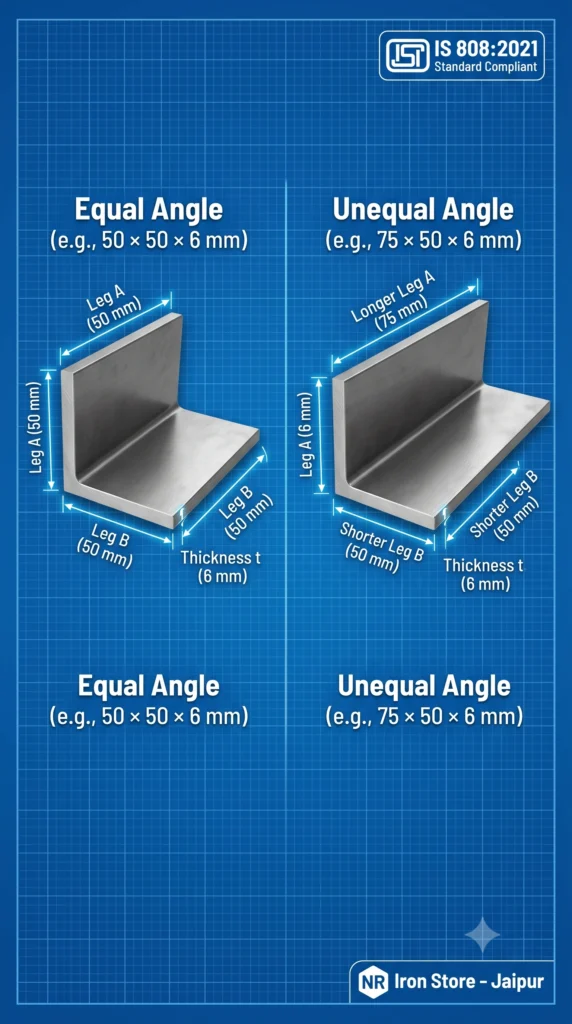
1. Equal Angle
An equal angle has two legs of the same nominal size.
For example:
50 × 50 × 6 mm
This means:
- First leg = 50 mm
- Second leg = 50 mm
- Thickness = 6 mm
Equal angles are useful where a symmetrical L-section is required.
2. Unequal Angle
An unequal angle has two legs with different dimensions.
For example:
75 × 50 × 6 mm
This means:
- Longer leg = 75 mm
- Shorter leg = 50 mm
- Thickness = 6 mm
Unequal angles can be useful when the design requires different leg widths.
IS 808 covers both equal and unequal-leg angle sections.
MS Angle Sizes and Dimensions
MS Angle dimensions are generally specified using:
Leg A × Leg B × Thickness
For example:
65 × 65 × 6 mm
means the angle has two 65 mm legs with a nominal thickness of 6 mm.
For an unequal angle:
75 × 50 × 6 mm
means one leg is 75 mm and the other is 50 mm.
Common MS Angle Size Examples
| Type | Example Size | Meaning |
| Equal Angle | 25 × 25 × 3 mm | 25 mm × 25 mm legs, 3 mm thickness |
| Equal Angle | 40 × 40 × 5 mm | 40 mm × 40 mm legs, 5 mm thickness |
| Equal Angle | 50 × 50 × 6 mm | 50 mm × 50 mm legs, 6 mm thickness |
| Equal Angle | 65 × 65 × 6 mm | 65 mm × 65 mm legs, 6 mm thickness |
| Equal Angle | 75 × 75 × 8 mm | 75 mm × 75 mm legs, 8 mm thickness |
| Unequal Angle | 75 × 50 × 6 mm | 75 mm and 50 mm legs, 6 mm thickness |
| Unequal Angle | 100 × 75 × 8 mm | 100 mm and 75 mm legs, 8 mm thickness |
Note: These are examples for understanding dimensions, not a guaranteed stock list. Standardized dimensions, mass and tolerances should be checked against the applicable specification and supplier availability. IS 808:2021 provides standardized angle-section dimensions and properties.
Understanding MS Angle Dimensions
Before ordering an MS Angle, make sure you understand all three dimensions.
Leg Length
Leg length tells you the width of each side of the L-section.
For example:
50 × 50 × 6 mm
has 50 mm legs.
Thickness
Thickness is the material thickness of the angle.
For example:
50 × 50 × 6 mm
has a nominal thickness of 6 mm.
Length
The angle is supplied in a specified or agreed length depending on the product and supplier.
For a purchase enquiry, clearly mention the required dimensions and quantity.
MS Angle Weight Calculation
Weight is an important consideration when buying steel because commercial steel purchases are commonly calculated by weight.
For a quick estimate, steel density of approximately 7,850 kg/m³ can be used.
For an angle section, a simple approximate method is:
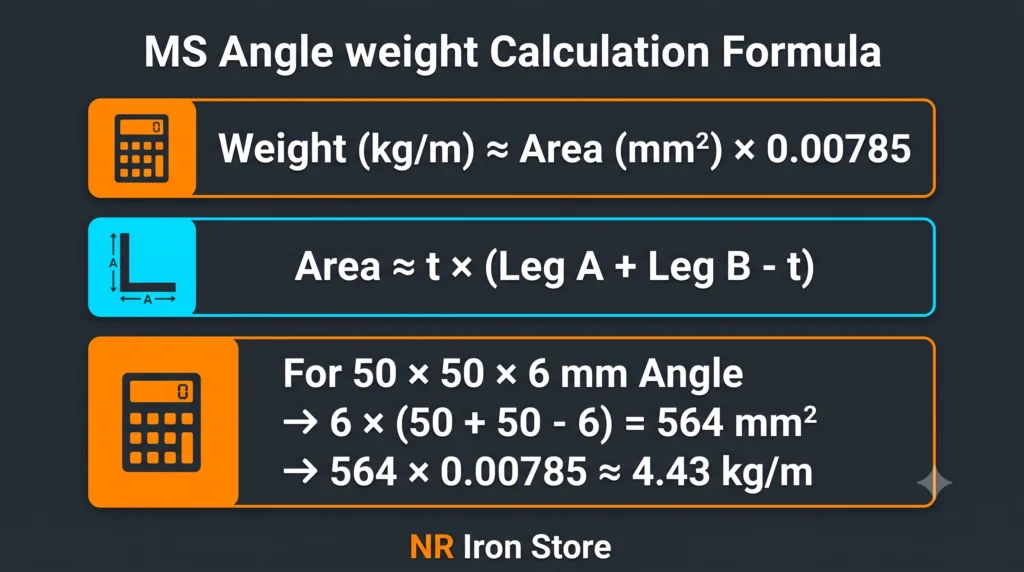
Weight per metre ≈ Cross-sectional area × 0.00785
when the dimensions are in mm and the resulting weight is in kg/m.
For actual standardized angle sections, it is better to use the published mass-per-metre value for the exact section.
IS 808:2021 includes nominal dimensions and mass for standardized angle sections.
Hypothetical Example
Suppose you need an angle with:
- Leg A = 50 mm
- Leg B = 50 mm
- Thickness = 6 mm
A simplified area estimate is:
Area ≈ t(A + B − t)
So:
6 × (50 + 50 − 6)
= 564 mm²
Approximate weight:
564 × 0.00785
= about 4.43 kg/m
This is an estimate.
For billing and procurement, use the applicable standard mass table or supplier’s actual supplied weight rather than relying only on a simplified formula.
Why MS Angle Weight Matters
Knowing approximate weight can help you estimate:
- Material requirement
- Transportation requirement
- Approximate project cost
- Total steel quantity
- Possible fabrication wastage
It can also make it easier to compare quotations from different suppliers.
Common Uses of MS Angles
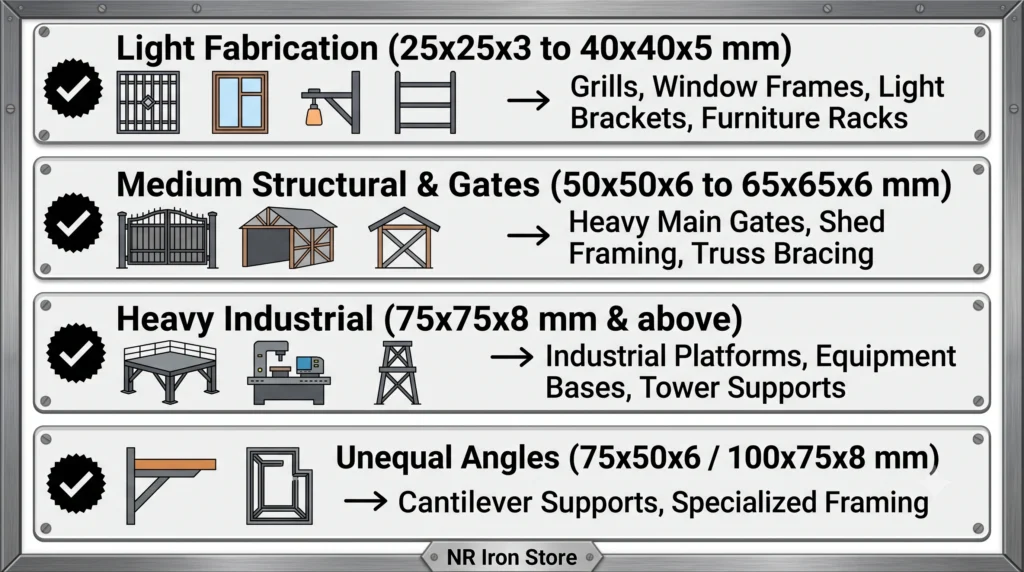
MS Angles are used in many construction, fabrication and engineering applications.
1. Structural Work
Depending on the design and applicable steel specification, angles can be used for:
- Structural frames
- Supports
- Bracing
- Steel structures
- General structural fabrication
The required section should always be selected according to the engineering design.
2. Fabrication
Fabricators commonly use MS Angles for:
- Frames
- Gates
- Grills
- Railings
- Brackets
- Supports
- Racks
The required size depends on the fabrication design.
3. Industrial Applications
MS Angles can also be used in:
- Equipment frames
- Machine supports
- Platforms
- Industrial structures
- General engineering fabrication
4. General Repair and Construction
Smaller angle sections can be useful for:
- Reinforcement of fabricated frames
- Corner supports
- Brackets
- General repair work
The application should determine the appropriate size and grade.
How to Choose the Right MS Angle Size
Selecting the correct MS Angle is more important than simply choosing a larger section.
Follow these steps.
Step 1: Identify the Application
First determine where the angle will be used.
For example:
- Gate
- Grill
- Frame
- Bracket
- Structural support
- Industrial fabrication
- Rack
Different applications require different section sizes.
Step 2: Decide Equal or Unequal Angle
Choose an equal angle when both legs need to be approximately the same size.
Choose an unequal angle when one leg needs to be wider than the other.
Step 3: Select Leg Dimensions
Check the required:
- Leg A
- Leg B
- Thickness
For example:
50 × 50 × 6 mm
or
75 × 50 × 6 mm
Step 4: Check Grade and Specification
For structural applications, don’t select an MS Angle only by size.
Confirm the required material grade and applicable specification from the project or engineer.
IS 808:2021 references IS 2062 for steel grades used with these structural sections.
BIS documentation for structural steel also addresses testing and certification requirements for material covered by the applicable standard.
Step 5: Check Weight and Quantity
Calculate or verify:
Total quantity = Number of pieces × Length × Approximate kg/m
This gives you a practical estimate of the required steel quantity.
Step 6: Check Tolerances
Dimensions are not expected to be perfectly identical to an unlimited number of decimal places.
IS 1852 specifies rolling and cutting tolerances for hot-rolled structural steel products, including equal and unequal-leg angles.
Therefore, for important structural or fabrication work, check the applicable tolerance requirements.
MS Angle Price in India
There is no single fixed MS Angle price in India.
The final rate can vary according to:
- Steel market conditions
- Grade
- Angle size
- Thickness
- Manufacturer
- Quantity
- Location
- Transportation
- Current availability
Because steel prices change, an old online price should not be treated as today’s confirmed market rate.
How to Estimate MS Angle Cost
A basic calculation is:
Estimated Cost = Total Weight × Rate per kg
Hypothetical Example
Suppose your requirement is:
- Quantity = 1,000 kg
- Quoted rate = ₹X/kg
Then:
Estimated material cost = 1,000 × ₹X
The actual quotation should be confirmed with the supplier at the time of purchase.
For a commercial requirement, provide the exact size, length and quantity when requesting a quotation.
MS Angle Price Per Kg vs Per Piece
Customers may receive quotations in different formats.
A supplier may quote:
- ₹/kg
- ₹/piece
- Total order value
If the price is quoted per piece, knowing the approximate weight can help you understand the effective rate.
For example:
Effective ₹/kg = Price per piece ÷ Weight per piece
This can make quotation comparisons easier.
How to Buy Quality MS Angles
Before purchasing, check the following:
- Correct angle type
- Correct leg dimensions
- Correct thickness
- Required length
- Grade/specification
- Surface condition
- Approximate or actual weight
- Quantity
- Applicable documentation
- Delivery requirement
For standardized structural angle sections, IS 808:2021 provides dimensional, mass and sectional-property information.
For tolerances, the applicable requirements of IS 1852 should also be considered.
MS Angle for Contractors and Builders
Contractors should provide clear specifications when requesting a quotation.
Instead of saying:
“MS angle ka rate batao.”
Give the supplier details such as:
50 × 50 × 6 mm MS Angle — required quantity 500 kg
If length is important, mention that as well.
This reduces confusion and makes quotations easier to compare.
MS Angle for Fabricators
Fabricators should pay particular attention to:
- Leg size
- Thickness
- Length
- Straightness
- Quantity
- Cutting requirement
The right dimensions can reduce unnecessary cutting and fabrication adjustments.
For repetitive fabrication jobs, ordering the correct section from the beginning can make material planning easier.
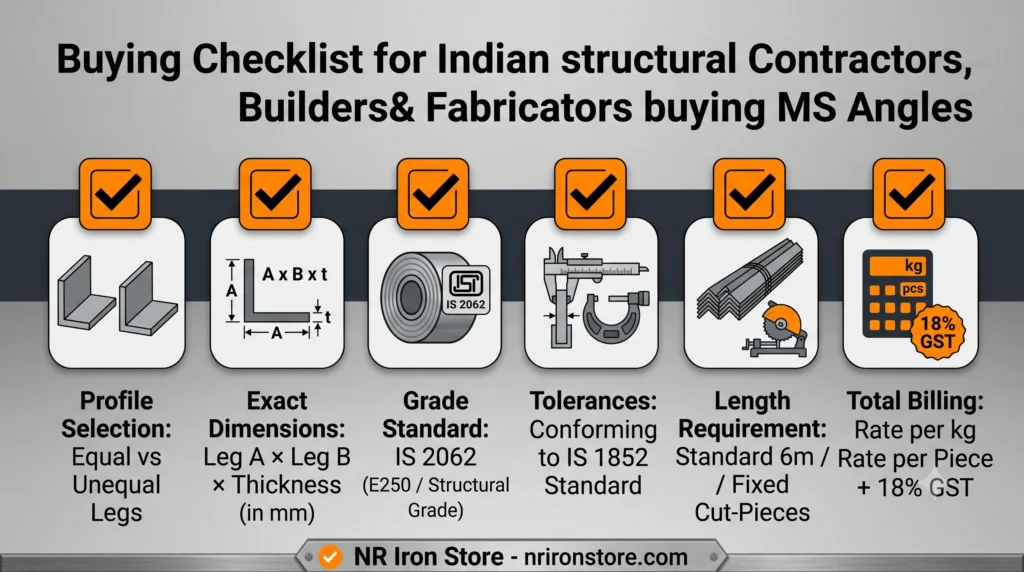
A Simple MS Angle Buying Checklist
Before placing your order, confirm:
- Application
- Equal or unequal angle
- Leg dimensions
- Thickness
- Length
- Grade/specification
- Quantity
- Approximate weight
- Current rate
- Delivery requirement
Key Takeaways
- MS Angle is an L-shaped hot-rolled steel section.
- MS Angles can be equal-leg or unequal-leg sections.
- Dimensions are commonly expressed as leg × leg × thickness.
- Weight depends on the cross-sectional area and length.
- For standardized sections, use the applicable mass-per-metre table rather than only an approximate formula.
- MS Angle prices vary according to size, grade, quantity, market conditions and location.
- IS 808:2021 covers dimensions, mass, tolerances and sectional properties of standardized hot-rolled angle sections.
- IS 1852 covers rolling and cutting tolerances for hot-rolled products including angles.
- For structural work, always follow the project specification and engineering requirements.
Frequently Asked Questions
1. What is an MS Angle?
An MS Angle is an L-shaped steel section generally used for structural, fabrication and engineering applications.
2. What is the difference between equal and unequal MS Angles?
An equal angle has two legs of the same nominal size, while an unequal angle has two legs of different sizes.
For example:
50 × 50 × 6 mm = equal angle.
75 × 50 × 6 mm = unequal angle.
3. How are MS Angle sizes written?
MS Angle sizes are generally written as:
Leg A × Leg B × Thickness
For example, 65 × 65 × 6 mm means two 65 mm legs with 6 mm nominal thickness.
4. How is MS Angle weight calculated?
A quick estimate can be made using:
Weight per metre ≈ Cross-sectional area × 0.00785
For standardized sections, the exact mass-per-metre value should be checked from the applicable standard.
5. What are MS Angles used for?
MS Angles can be used for structural work, frames, brackets, supports, gates, grills, racks, industrial fabrication and other engineering applications.
6. What affects MS Angle price in India?
Price can depend on grade, size, thickness, manufacturer, quantity, steel market conditions, location, freight and availability.
7. How do I choose the right MS Angle size?
Start with the application, then determine equal or unequal angle, leg dimensions, thickness, grade/specification, length and quantity.
For structural applications, the final selection should follow the project design.
8. Where can I buy MS Angles in Jaipur?
You can contact NR Iron Store with your required MS Angle size, quantity and delivery requirement to request a current quotation.
Looking for MS Angles?
Need MS Angle / Mild Steel Angle for construction, fabrication, structural work or general engineering?
Send NR Iron Store your required:
Size + Thickness + Quantity + Length
and request a current quotation.
Get a Quote from NR Iron Store today.
Website: nrironstore.com
About the Author
Author: Muhammad Ahmad
Designation: Founder & Steel Operations Lead
Experience: 6+ Years in Steel Distribution & Fabrication Supply
Expertise: Steel products and MS Angle information
Author Bio:
Muhammad Ahmad leads operations at NR Iron Store. With hands-on industry experience in steel trading and fabrication supplies, he creates practical guides to help Indian contractors, builders, and fabricators understand material specifications, grades, and quality standards before purchasing.