If you work in construction, fabrication, plumbing, agriculture or general engineering, you have probably come across mild steel pipe, commonly called MS pipe.But what exactly is an MS pipe, and why is it used so widely?A mild steel pipe is a steel pipe made from low-carbon steel. Its relatively low carbon content makes it suitable for fabrication, welding and forminMS pipes are available in different sizes, thicknesses, grades, manufacturing processes and surface finishes.In India, the appropriate specification depends on the intended application. For example, IS 1239 Part 1 covers steel tubes intended for water, non-hazardous gas, air and steam and includes different classes and sizes.In this guide, we will explain the mild steel pipe meaning, definition, properties, types, uses and important buying considerations in simple language.
Mild Steel Pipe Meaning & Definition
What is the meaning of mild steel pipe?
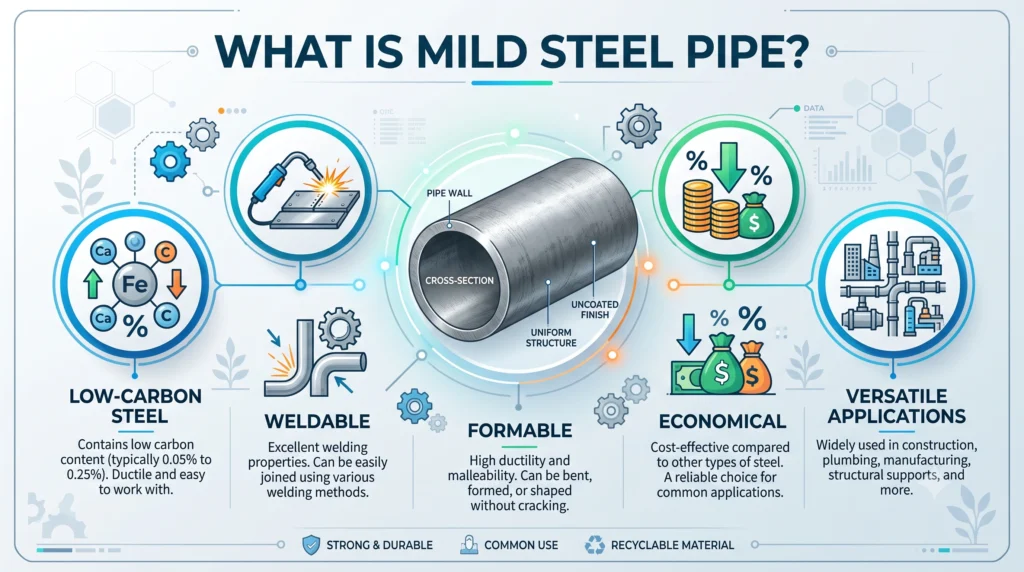
Mild steel pipe means a pipe manufactured from low-carbon steel.Because mild steel has relatively low carbon content, it is generally easier to weld and form than higher-carbon steels. Jindal Pipes describes MS pipes as low-carbon steel pipes that can be welded and formed into different shapes and sizes.
Simple Mild Steel Pipe Definition
Mild steel pipe is a tubular steel product made from low-carbon steel and used for applications such as structural work, fabrication, plumbing, irrigation and general engineering, depending on its specification.The term “MS pipe” is commonly used in the Indian market, but the exact specification still matters.A pipe selected for structural fabrication may have different requirements from one intended for water service or another engineering application.
Properties of Mild Steel Pipe
The properties of an MS pipe depend on its steel grade, manufacturing method, dimensions and applicable standard. Some commonly valued properties include:
1. Good Weldability
Low-carbon mild steel is generally suitable for welding. This makes MS pipe useful for fabrication work where pipes need to be joined to other steel components.
2. Formability
Mild steel can generally be formed more easily than higher-carbon steels. This is useful when fabrication requires bending or shaping.
3. Strength
Steel provides useful mechanical strength for structural and engineering applications. However, the actual load-bearing capacity of a particular pipe should be checked from its grade, dimensions and design requirements rather than assuming that every MS pipe has the same strength.
4. Ductility
Low-carbon steel is generally ductile, meaning it can deform to some extent before failure. The exact mechanical properties depend on the particular grade and specification.
5. Machinability
MS pipes can be cut, drilled and fabricated using appropriate tools and processes.
6. Corrosion Consideration
Plain mild steel can rust when exposed to moisture and oxygen. For applications where corrosion resistance is important, protective measures such as painting or galvanizing may be considered. Jindal Pipes notes that MS pipes are commonly coated with metals, paint or varnish to help prevent rusting.
Types of Mild Steel Pipe
MS pipes can be classified in several ways. The right classification depends on whether you are looking at manufacturing process, surface finish, application, size or specification.
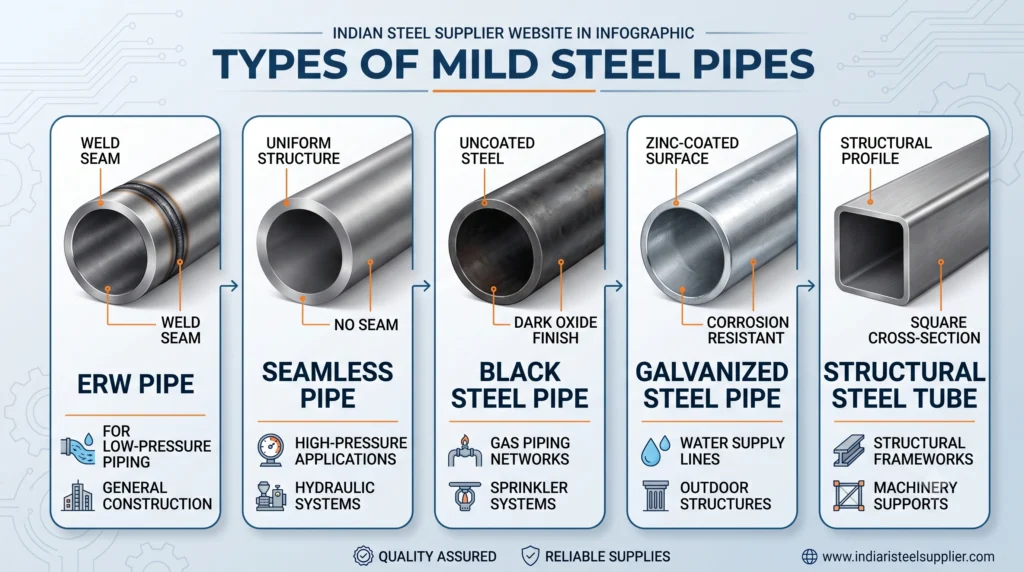
1. ERW MS Pipe
ERW stands for Electric Resistance Welded. ERW pipes are manufactured by forming steel strip or coil into a cylindrical shape and joining the edges using an electric resistance welding process. They are widely used for general engineering, structural and fabrication applications.
2. Seamless MS/Carbon Steel Pipe
Seamless pipes are produced without a longitudinal welded seam.`
They are selected for applications where the required specification calls for seamless construction and suitable mechanical or pressure performance.
The term “seamless” alone does not automatically mean a pipe is suitable for a particular pressure application; the relevant grade and standard must always be checked.
3. Black MS Pipe
Black pipe generally refers to steel pipe with an ungalvanized, dark mill-finished surface.
It is commonly used in fabrication and engineering applications where a galvanized surface is not required.
4. Galvanized MS Pipe
Galvanized pipe has a zinc coating intended to provide additional protection against corrosion.
The appropriate galvanizing specification depends on the intended application.
BIS documents for IS 1239 Part 1 include black and galvanized surface conditions for covered steel tubes.
5. Structural MS Pipe
Some steel tubes are specifically manufactured for structural purposes.
For example, IS 1161:2014 is the Indian Standard for steel tubes for structural purposes. BIS lists this standard among its product-specific standards.
How Are MS Pipes Manufactured?
The manufacturing process depends on the type of pipe.
For a typical welded pipe, the basic process can be understood as:
Steel coil → Forming → Welding → Sizing → Inspection → Cutting → Finishing
The steel material is formed into the required tubular shape and the edges are joined.
After manufacturing, dimensions and other required characteristics are checked according to the applicable specification.
For example, BIS information relating to IS 1239 Part 1 identifies requirements and testing related to dimensions, mass, tensile properties, elongation, bend/flattening tests, workmanship and leak-proof testing.
Common Uses of Mild Steel Pipe
MS pipes are used across construction, fabrication, agriculture, engineering and infrastructure.
Construction & Fabrication
Common applications include:
- Structural frameworks
- Railings
- Gates
- Fencing
- Supports
- Fabricated structures
- General workshop fabrication
Plumbing & Water Applications
Steel tubes manufactured to suitable specifications can be used for water-related applications.
IS 1239 Part 1, for example, covers steel tubes intended for water, non-hazardous gas, air and steam.
Agriculture & Irrigation
MS pipes can be used in agricultural and irrigation-related installations where the pipe specification matches the requirements of the application.
Firefighting
Suitable steel pipes are also used in firefighting installations.
The exact pipe specification should be selected according to the system’s design and applicable standards.
HVAC & Engineering
MS pipes can also be used in HVAC and general engineering applications. Jindal Pipes identifies plumbing, firefighting, HVAC, agriculture, irrigation, housing and engineering among MS pipe application areas.
MS Pipe vs MS Tube
The words pipe and tube are often used interchangeably in everyday conversation, but technically they can refer to different product categories and standards.
| Factor | MS Pipe | MS Tube |
| Typical use | Fluid transport, fabrication and engineering | Structural and fabrication applications |
| Shape | Usually circular | Circular, square or rectangular depending on product |
| Sizing | Often specified by nominal bore/diameter and wall thickness | Often specified by outside dimensions and thickness |
| Standards | Depends on application | Depends on application |
| Selection | Based on service requirements | Based on structural/fabrication requirements |
The important point is not to select a product based only on the name “pipe” or “tube.”
Check the dimensions, material grade, wall thickness and applicable standard.
Advantages and Limitations
Advantages of Mild Steel Pipe
- Good weldability
- Relatively easy fabrication
- Available in many sizes and specifications
- Suitable for many construction and engineering applications
- Can be painted or coated for additional protection
- Widely used across fabrication and industrial work
Limitations
- Plain mild steel can corrode when exposed to moisture
- Not every MS pipe is suitable for pressure service
- Different applications require different specifications
- Incorrect wall thickness can affect performance
- Protective coating may be required in corrosive environments
Important: Pipe selection should always consider the actual operating conditions and applicable standard.
How to Choose the Right MS Pipe
Buying an MS pipe is not simply about choosing the largest or thickest pipe.
Consider these factors first.
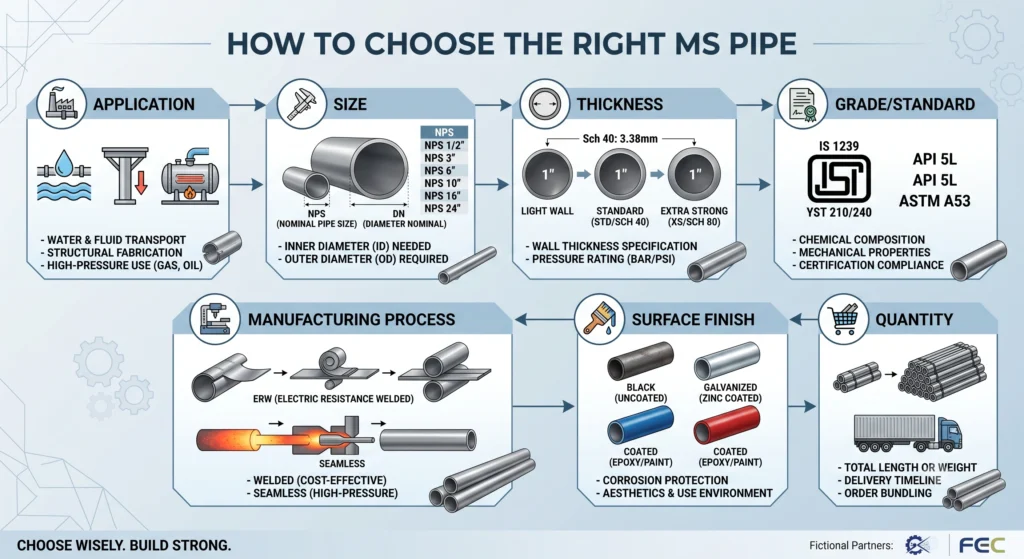
1. Application
Ask what the pipe will actually be used for.
Is it for:
- Fabrication?
- Structural work?
- Water?
- Irrigation?
- HVAC?
- Firefighting?
- General engineering?
2. Diameter or Size
The required diameter depends on the application and design.
For fluid applications, internal flow requirements are particularly important.
3. Wall Thickness
Thickness affects the pipe’s mass, dimensions and mechanical performance.
Do not select thickness based only on price.
4. Manufacturing Process
Determine whether the project requires welded or seamless pipe.
The choice should be based on the applicable design and specification.
5. Surface Finish
Choose between black, painted, galvanized or another suitable finish depending on the environment and application.
6. Applicable Standard
This is one of the most important checks.
For example, IS 1239 Part 1 covers certain steel tubes for water, non-hazardous gas, air and steam, while IS 1161 covers steel tubes for structural purposes.
7. Quantity and Budget
For commercial projects, compare the required specification, quantity and delivered price rather than comparing only the per-piece price.
Example: Builders use MS Pipes for construction
Hypothetical example: A fabricator needs steel pipes for making a gate and supporting frame.
Instead of simply asking for “MS pipe,” the buyer should specify:
- Required pipe shape
- Outside dimensions
- Wall thickness
- Quantity
- Required surface finish
- Intended application
- Relevant specification, where applicable
This helps the supplier provide a product that matches the actual requirement.
Buying MS Pipe in India
When purchasing MS pipes, it is useful to ask the supplier for the product details before placing the order.
A simple checklist is:
Size + Thickness + Grade/Specification + Finish + Quantity + Application
For projects where standards matter, ask whether the supplied product complies with the required Indian Standard or project specification.
For example, BIS identifies IS 1239 Part 1 as a standard covering steel tubes and provides testing information for properties such as dimensions, tensile strength, elongation, bend/flattening and leak-proof performance.
Key Takeaways
- Mild steel pipe is a low-carbon steel tubular product.
- MS pipes are valued for their weldability and ease of fabrication.
- They are used in construction, fabrication, plumbing, irrigation and engineering applications.
- MS pipes can be welded or seamless depending on the product and specification.
- Black and galvanized finishes are available for different requirements.
- Always select the pipe based on application, size, thickness, grade and applicable standard.
- A thicker pipe is not automatically the right pipe; the specification must match the job.
Frequently Asked Questions
1. What is mild steel pipe?
Mild steel pipe is a tubular steel product manufactured from low-carbon steel. It is commonly used in fabrication, construction, plumbing, irrigation and engineering applications.
2. What is the difference between MS pipe and mild steel pipe?
There is generally no difference in the basic material meaning. MS pipe is simply the commonly used abbreviation for mild steel pipe.
3. What are the main properties of mild steel pipe?
Commonly valued properties include good weldability, formability, ductility and useful mechanical strength. Exact properties depend on the grade, dimensions and applicable specification.
4. What are the common types of MS pipes?
Common categories include ERW pipes, seamless pipes, black pipes, galvanized pipes and structural steel tubes. The appropriate type depends on the application and specification.
5. Where is mild steel pipe used?
MS pipes are used in construction, fabrication, agriculture, irrigation, plumbing, firefighting, HVAC and general engineering applications, depending on the product specification.
6. Can MS pipes rust?
Yes. Plain mild steel can corrode when exposed to moisture and oxygen. Painting, galvanizing or another suitable protective system can help reduce corrosion.
7. How do I choose the right MS pipe?
Consider the application, pipe size, wall thickness, grade/specification, manufacturing process, surface finish and quantity before buying.
8. Is every MS pipe suitable for water or pressure applications?
No. Pipe suitability depends on the applicable standard, grade, dimensions and system requirements. For example, IS 1239 Part 1 specifies requirements for certain steel tubes intended for water, non-hazardous gas, air and steam.
Need MS Pipes for Your Project?
Looking for the right mild steel pipe for construction, fabrication, irrigation or general engineering work?
NR IRON STORE can help you choose MS pipes according to your required size, thickness, finish and application.
Need a price or product availability? Get a Quote from NR IRON STORE today.
About the Author
Author: Muhammad Ahmad
Designation: Founder & Steel Operations Lead
Experience: 6+ Years in Steel Distribution & Fabrication Supply
Expertise: Steel products and MS Pipe information
Author Bio:
Muhammad Ahmad leads operations at NR Iron Store. With hands-on industry experience in steel trading and fabrication supplies, he creates practical guides to help Indian contractors, builders, and fabricators understand material specifications, grades, and quality standards before purchasing.