If you have visited an iron or steel market, you may have heard terms such as MS flat, MS patti or mild steel flat bar. But what exactly is an MS flat, and where is it used?
An MS flat is a flat, rectangular steel section made from mild or low-carbon steel. Its simple shape makes it useful for fabrication, construction, engineering and many general-purpose applications.
MS flats are available in different widths and thicknesses, allowing fabricators and contractors to select a section according to their project requirements. In this guide, we will explain the MS flat meaning, definition, properties, types, sizes, weight, uses and buying considerations in simple language.
MS Flat Meaning & Definition
What is the meaning of MS flat?
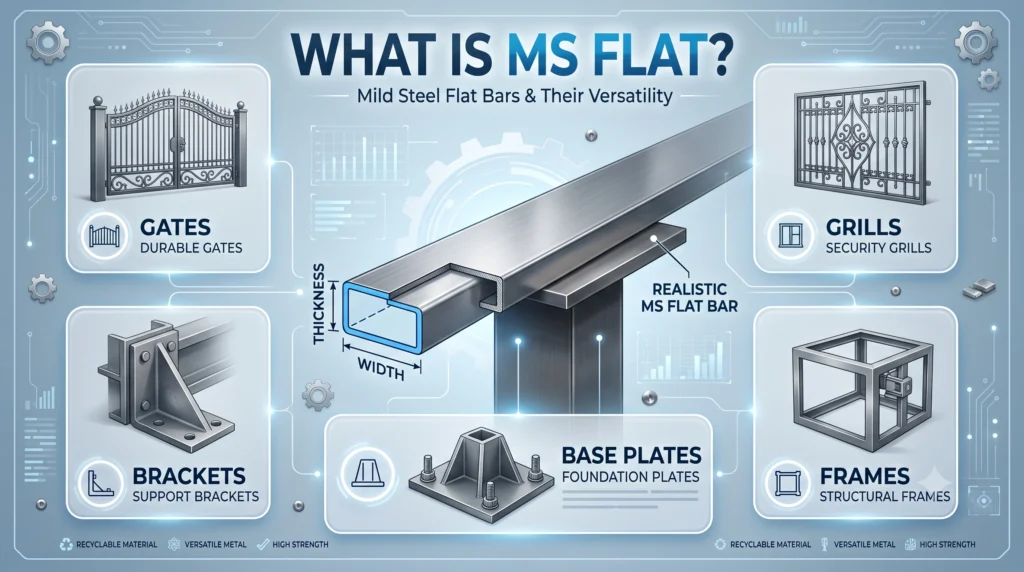
MS flat means Mild Steel Flat Bar.
It is a rectangular steel section with a flat surface and relatively uniform width and thickness. In India, fabricators commonly call it MS patti or simply patti. The dimensions are generally expressed as width × thickness.
For example:
50 × 6 mm MS Flat
means the flat bar is approximately 50 mm wide and 6 mm thick.
A supplier should confirm the applicable product standard, dimensions and tolerances for the material being supplied.
Simple MS Flat Definition
An MS flat is a rectangular flat steel bar made from mild or low-carbon steel and commonly used for fabrication, construction, supports, brackets, frames, base plates and other engineering applications.
Because of its flat profile, it can be easily cut, drilled, welded and fabricated for different purposes.
Properties of MS Flats
The exact mechanical properties of an MS flat depend on its grade, manufacturing process and applicable standard.
However, mild steel flat bars are commonly valued for the following characteristics.
1. Good Weldability
Low-carbon steel is generally suitable for welding. This makes MS flats useful for gates, frames, brackets, supports and other fabricated assemblies.
2. Formability
MS flats can generally be cut, bent and shaped using suitable fabrication processes. This makes them practical for workshops where steel sections need to be modified according to a design.
3. Strength
Steel provides useful mechanical strength for structural and engineering applications. However, the strength of an MS flat should always be checked against its actual grade and specification rather than assuming that every flat bar has identical properties.
4. Ductility
Mild and low-carbon steels generally have useful ductility. This allows the material to undergo some deformation before failure, depending on the grade and condition.
5. Easy Fabrication
MS flats can be:
- Cut
- Drilled
- Welded
- Bent
- Machined
- Painted or coated
This versatility is one reason they are commonly used in fabrication work.
6. Corrosion Consideration
Plain mild steel can rust when exposed to moisture and oxygen. For outdoor or corrosive environments, painting, galvanizing or another suitable protective coating may be considered.
Common Types of MS Flats
MS flats can be classified according to their material grade, manufacturing condition, surface finish and application.
1. Hot-Rolled MS Flats
Hot-rolled flats are commonly supplied for construction, fabrication and general engineering applications.
They generally have a mill-finished surface and are available in a range of widths and thicknesses.
2. Structural-Grade MS Flats
Where structural performance is important, the purchaser should specify the required structural steel grade and applicable standard.
For example, IS 2062 is an Indian Standard associated with weldable structural steel grades. The exact grade should be selected according to the design and project requirements.
3. Galvanized MS Flats
A galvanized flat has a zinc coating intended to provide additional corrosion protection.
These can be useful where the steel will be exposed to environmental conditions and a suitable galvanized specification is required.
4. Bright/Cut-to-Size Flats
Some flat steel products are supplied with more controlled dimensions or specific surface conditions for engineering and fabrication work.
These should not automatically be treated as interchangeable with standard hot-rolled MS flats.
MS Flat Sizes & Weight
One of the most important things to understand when buying an MS flat is its width and thickness.
For example:
| MS Flat Size | Approx. Theoretical Weight |
| 20 × 3 mm | 0.47 kg/m |
| 25 × 3 mm | 0.59 kg/m |
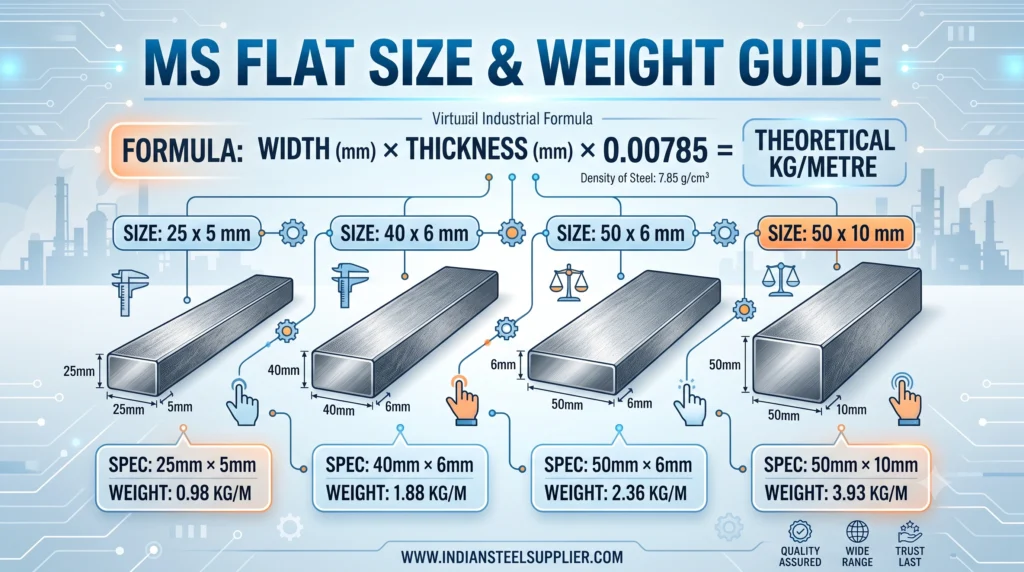
| 25 × 5 mm | 0.98 kg/m |
| 32 × 6 mm | 1.51 kg/m |
| 40 × 6 mm | 1.88 kg/m |
| 50 × 6 mm | 2.36 kg/m |
| 50 × 10 mm | 3.93 kg/m |
| 65 × 6 mm | 3.06 kg/m |
| 75 × 8 mm | 4.71 kg/m |
| 100 × 10 mm | 7.85 kg/m |
These are theoretical weights calculated from dimensions and steel density; actual supplied weight can vary within applicable manufacturing tolerances.
MS Flat Weight Formula
A convenient theoretical calculation is:
Weight per metre ≈ Width × Thickness × 0.00785
where width and thickness are in millimetres.
Example
For a 50 × 6 mm MS flat:
50 × 6 × 0.00785 = 2.355 kg/m
So the theoretical weight is approximately 2.36 kg per metre.
For a 6-metre length:
2.355 × 6 = 14.13 kg
Actual commercial weight may differ because of manufacturing tolerances.
How MS Flats Are Made
MS flats are generally produced through steel rolling processes.
A simplified manufacturing sequence is:
Steel → Heating → Rolling → Sizing → Cooling → Cutting → Inspection
The steel is passed through rolling equipment to obtain the required rectangular cross-section.
After rolling, the product is cut into required lengths and checked for dimensions and other specified requirements.
The applicable Indian standard should be checked for the specific product being purchased.
For example, BIS maintains standards relating to dimensions and tolerances for different steel bar products.
Uses of MS Flats
One of the biggest advantages of MS flats is their versatility.
They can be found in construction sites, fabrication workshops, engineering units and manufacturing applications.
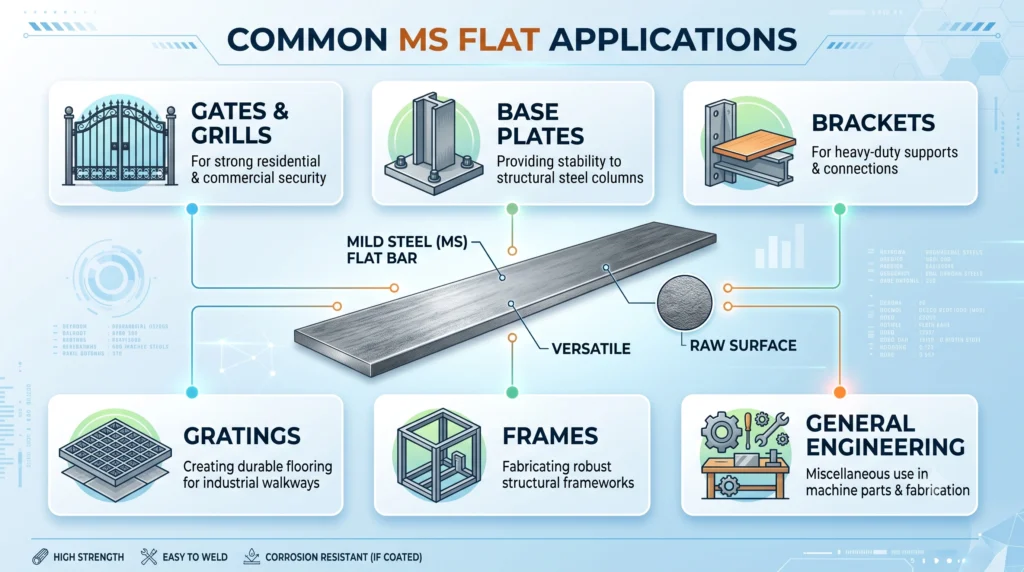
1. Gates and Grills
MS flats are commonly used for making:
- Gates
- Window grills
- Railings
- Fencing
- Decorative frames
Their flat surface makes them convenient for cutting and welding.
2. Base Plates
Flat bars can be used in fabricated structures as base plates, brackets and support components, provided the selected size and grade meet the design requirements.
3. Brackets and Supports
Fabricators use MS flats to manufacture different brackets, supports and mounting components.
4. Gratings
MS flats are used as components in fabricated steel gratings.
They can be combined with other steel sections to create load-bearing or access surfaces designed for specific applications.
5. Frames
MS flats can be incorporated into:
- Machine frames
- Structural frames
- Equipment supports
- Fabricated assemblies
6. Automotive & Transport Fabrication
Steel flat sections are also used in various fabricated components for trailers, truck bodies and other transport-related structures.
7. General Engineering
MS flats can be used for:
- Clamps
- Brackets
- Washers
- Flanges
- Machine components
- Repair work
- General fabrication
The appropriate grade and dimensions depend on the particular application.
Example: MS Flat for Gate Fabrication
Hypothetical example: A fabricator is making a steel gate.
Instead of simply asking for “MS patti,” the fabricator should identify:
- Required width
- Required thickness
- Length
- Quantity
- Grade/specification if required
- Surface finish
- Intended use
For example, a project may require a particular flat size for a frame and another size for decorative or supporting components.
The final selection should be based on the gate design and fabrication requirements.
Advantages and Limitations
Advantages of MS Flats
- Simple rectangular shape
- Easy to cut and fabricate
- Generally weldable
- Available in many dimensions
- Useful for construction and fabrication
- Can be painted or coated
- Suitable for a wide range of engineering applications
Industry suppliers commonly list applications including base plates, brackets, frames, gratings, gates, machinery components and general fabrication.
Limitations
- Plain MS can corrode in wet environments
- Different grades have different mechanical properties
- Incorrect dimensions may affect structural performance
- Not every MS flat is suitable for every load-bearing application
- Surface protection may be needed for outdoor exposure
How to Choose the Right MS Flat
Before buying MS flats, don’t focus only on the price per kilogram. Instead, First identify what the flat will actually be used for.
1. Application
For example, determine whether MS flat is required for:
- Gate or grill fabrication
- Structural work
- Base plates
- Brackets
- Gratings
- Machinery
- General fabrication
2. Width
The width is determines the overall flat surface available for the application.
3. Thickness
Thickness affects the section’s weight and mechanical characteristics.
For structural applications, thickness should be selected according to the design rather than simply choosing the cheapest available option.
4. Grade
If a particular grade is required, mention it clearly while ordering.
For structural work, the applicable standard and grade should be confirmed.
5. Length
Check whether you need standard commercial lengths or cut-to-size material.
6. Surface Finish
Depending on the application, you may require:
- Mill finish
- Painted
- Galvanized
- Another specified finish
7. Quantity
For larger projects, calculate the total required length and approximate weight before ordering.
This makes it easier to compare quotations from suppliers.
MS Flat vs MS Angle
MS flats and MS angles are both commonly used in fabrication, but their shapes are different.
| Feature | MS Flat | MS Angle |
| Cross-section | Flat rectangular | L-shaped |
| Common use | Plates, brackets, frames, fabrication | Frames, supports, structural members |
| Fabrication | Easy to cut and weld | Easy to fabricate and join |
| Main dimensions | Width × thickness | Leg × leg × thickness |
| Shape | Flat | L-section |
The correct section depends on the design.
A flat bar should not automatically be substituted for an angle because the geometry and structural behaviour are different.
MS Flat vs MS Plate
These products can also look similar, but they are generally used differently.
| Feature | MS Flat | MS Plate |
| Form | Long rectangular bar | Large flat sheet/plate |
| Typical dimensions | Width × thickness | Length × width × thickness |
| Common uses | Brackets, frames, fabrication | Base plates, structures, machinery and fabrication |
| Handling | Usually supplied in long lengths | Usually supplied as sheets/plates |
The exact product category and dimensions should be confirmed with the supplier.
Key Takeaways
- MS flat means Mild Steel Flat Bar, also commonly called MS patti.
- It has a flat rectangular cross-section.
- MS flats are commonly used for fabrication, construction and engineering.
- Common applications include gates, grills, brackets, base plates, frames and gratings.
- MS flat sizes are generally specified by width × thickness.
- Theoretical weight can be estimated using Width × Thickness × 0.00785.
- Always select the grade, size and thickness according to the actual application.