Roofing Nalidar Sheets are corrugated or profiled sheets used for roofing and cladding applications.
The word “nalidar” is commonly used in the Indian market for sheets having a corrugated or ribbed profile.
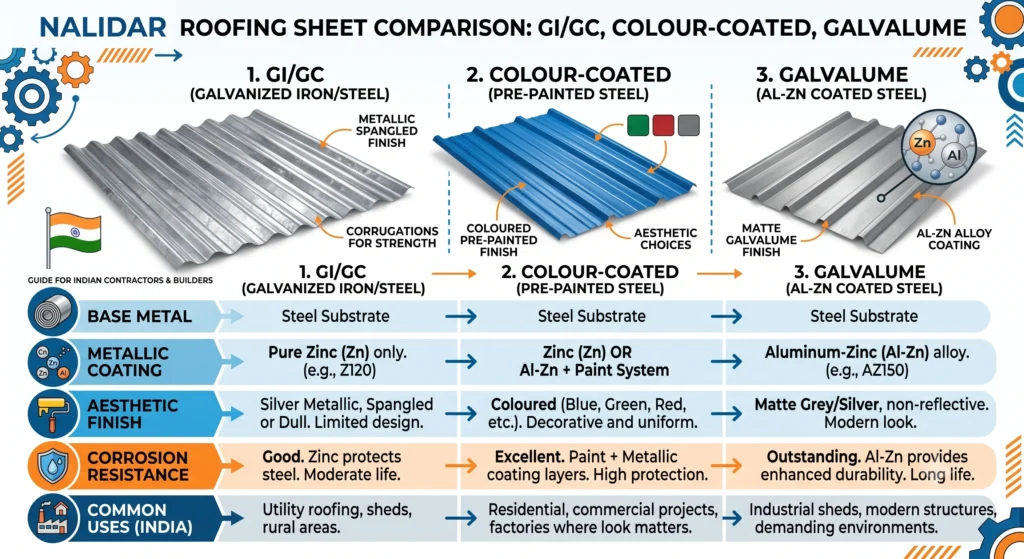
Depending on the product, nalidar roofing sheets may be manufactured from galvanized steel, colour-coated steel, galvalume/aluzinc-coated steel or other roofing materials.
For galvanized steel products, IS 277:2018 covers galvanized steel strips and sheets, including plain and corrugated sheets. BIS notes that corrugations can add strength and improve handling and installation, which is why corrugated galvanized sheets are commonly used for roofing.
What are Metal Roofing Sheets?
Metal roofing sheets are roofing products made from metal substrates such as steel or aluminium.
Common steel roofing options include:
- GI/GC sheets
- Colour-coated galvanized sheets
- Galvalume/aluzinc sheets
- PPGI/PPGL profile sheets
- Other profiled steel roofing products
The correct product depends on the building, environment, design and required service conditions.
Types of Nalidar Roofing Sheets
Not every nalidar sheet is the same.
The material, coating, thickness, profile and finish can vary considerably.
1. GI Nalidar Sheets
GI, or galvanized steel, sheets have a zinc coating that provides protection to the underlying steel.
BIS describes galvanized sheets as being used for applications including roofing, panelling and other applications where corrosion resistance is required.
These sheets are commonly available in a silver/metallic finish.
2. GC Sheets
GC commonly refers to galvanized corrugated sheets.
The corrugated profile gives the sheet its characteristic ribbed appearance.
They can be used for suitable roofing and cladding applications.
3. Colour-Coated Nalidar Sheets
These sheets use a coated steel substrate with a coloured top surface.
They are often selected when appearance is important along with roofing functionality.
BIS separately covers continuously pre-painted galvanized steel sheets and strips under IS 14246:2024, including products intended for roofing and architectural siding.
4. Galvalume/Aluzinc Roofing Sheets
These use a metallic coating system based on aluminium and zinc rather than a conventional zinc-only coating.
They are commonly available in profiled roofing forms.
Always confirm the exact coating specification and manufacturer’s product details before comparing them with GI sheets.
5. Profiled Roofing Sheets
Profiled sheets are formed into specific shapes such as corrugated or trapezoidal profiles.
The profile increases geometric stiffness compared with a flat sheet.
GI vs Colour-Coated vs Galvalume Nalidar Sheets
| Feature | GI/GC | Colour-Coated | Galvalume/Aluzinc |
| Base material | Steel | Steel | Steel |
| Metallic coating | Zinc | Metallic coating + paint system | Aluminium-zinc coating |
| Appearance | Metallic/silver | Coloured | Metallic or coated |
| Common use | Utility roofing | Roofing + appearance | Roofing/cladding |
| Main consideration | Zinc coating & thickness | Coating system & thickness | Coating specification & environment |
| Price | Varies | Usually product-specific | Varies |
The table is a practical purchasing comparison, not a statement that one product is universally superior.
Nalidar Sheet Sizes Available
Nalidar roofing sheets can be supplied in different widths and lengths.
Unlike flat sheets, roofing sheets also have to be considered in terms of profile and effective coverage width.
Common market dimensions
Depending on the supplier and profile, you may encounter:
- 3 ft width
- 4 ft width
- Around 1,000–1,250 mm widths
- Custom lengths
- Standard lengths such as 6 ft, 8 ft, 10 ft, 12 ft and longer sheets
One Indian supplier listing for GI nalidar sheets specifies lengths of 2,000–6,000 mm and widths of 600–1,500 mm, with thicknesses of 0.5–3 mm.
A Jaipur supplier listing for steel nalidar sheets shows a 4 ft width and 22 ft length for a particular product, demonstrating that longer custom/product-specific lengths are also available.
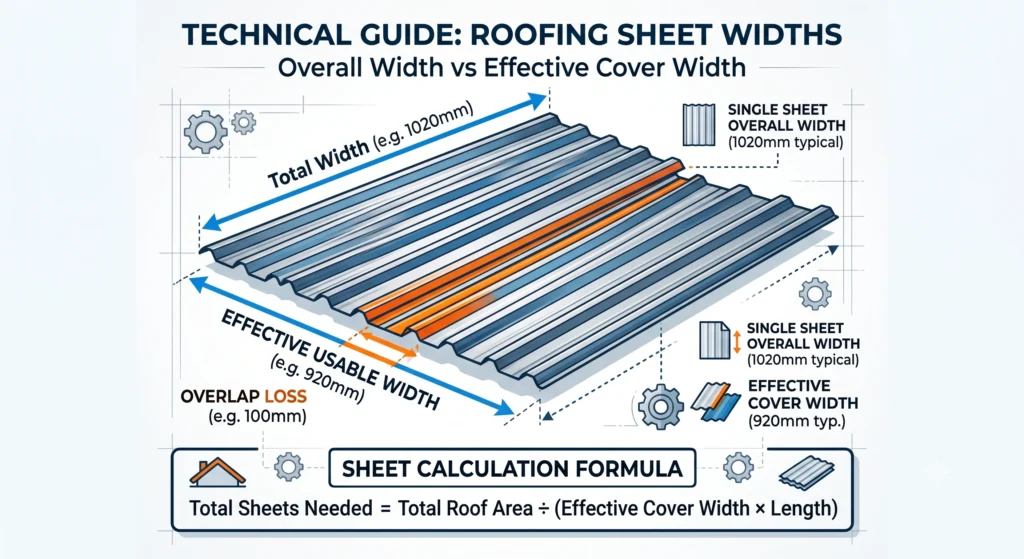
Important: Overall Width vs Effective Width
When buying roofing sheets, ask about effective cover width.
The actual width of a sheet is not always the same as the width covered after overlapping adjacent sheets.
For example, if two sheets overlap along their side laps, part of the physical width is used for the overlap.
Therefore, roof-area calculations should use the manufacturer’s specified effective cover width.
Nalidar Sheet Thickness
Thickness is one of the most important specifications when selecting a roofing sheet.
Market products vary significantly.
For example, a listed GI nalidar product shows 0.5–3 mm thickness availability, while a Jaipur listing for a particular coated nalidar galvanized sheet shows 0.5–1 mm.
Common market thicknesses may include:
- 0.30 mm
- 0.35 mm
- 0.40 mm
- 0.45 mm
- 0.50 mm
- 0.60 mm
- 0.80 mm
- 1.00 mm
- Higher thicknesses for specific products
Actual availability depends on the material, profile, manufacturer and supplier.
Why Thickness Matters
Thickness affects:
- Sheet weight
- Rigidity
- Handling
- Span suitability
- Fabrication
- Material cost
- Overall roofing system design
Do not choose thickness only by price.
For a roofing project, the required thickness should be selected according to the design, support spacing, loading conditions, environment and manufacturer’s recommendations.
Nalidar Roofing Sheet Weight
Roofing sheets are frequently sold on a per-kg basis, although some suppliers quote per piece or per square foot.
Weight depends on:
- Sheet dimensions
- Base steel thickness
- Coating
- Profile
- Material density
For a flat-sheet theoretical estimate, steel weight can be approximated using:
Weight ≈ Length × Width × Thickness × 7.85
where length and width are in metres and thickness is in millimetres.
For a corrugated sheet, this simple formula is only an approximation because the formed profile changes the actual developed area.
For accurate procurement, use the manufacturer’s declared weight or weigh the supplied material where necessary.
How to Estimate Roofing Sheet Quantity
Suppose a hypothetical roof has an area of 1,000 sq ft.
You should not simply divide 1,000 by the overall sheet width.
Instead, consider:
- Overall sheet width
- Effective cover width
- Sheet length
- Side overlap
- End overlap
- Roof slope
- Cutting/wastage requirements
Example
If a particular profile has an effective cover width of 3.5 ft, a sheet of 10 ft length would provide approximately:
3.5 × 10 = 35 sq ft of effective coverage
For a 1,000 sq ft roof:
1,000 ÷ 35 ≈ 28.6 sheets
So the basic calculation would require about 29 sheets, before considering slope, cutting, overlaps at ends and project-specific wastage.
This is a hypothetical calculation. Always use the manufacturer’s effective cover width and the actual roof dimensions before ordering.
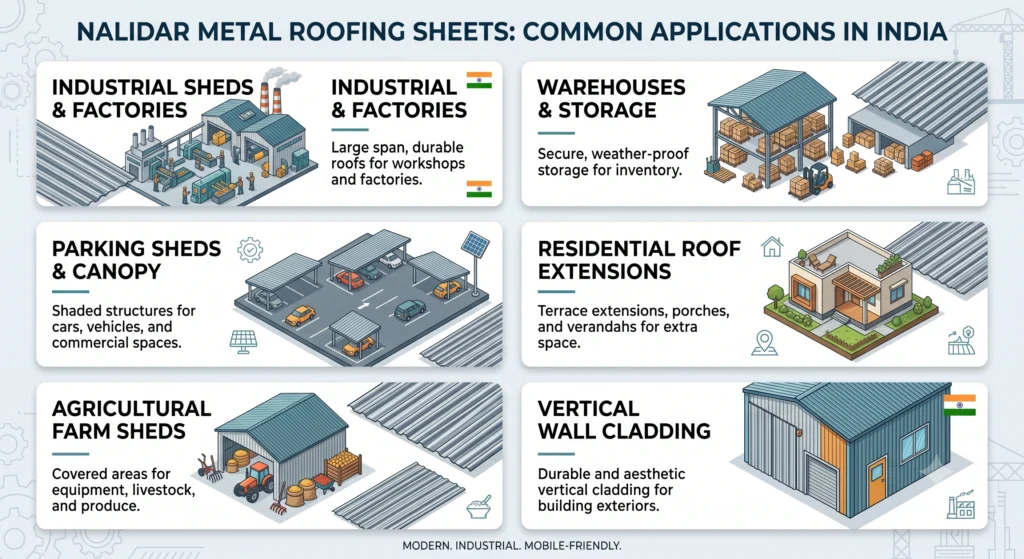
Common Uses of Nalidar Roofing Sheets
1. Residential Roofing
Metal roofing sheets can be used for suitable residential structures, extensions, sheds and utility areas.
The product should be selected according to the required appearance, durability and environmental conditions.
2. Industrial Sheds
Nalidar sheets are widely used in suitable industrial roofing systems.
The profile can provide useful rigidity while keeping the roof structure relatively lightweight compared with some traditional roofing materials.
3. Warehouse Roofing
Metal roofing sheets are commonly considered for warehouses and storage buildings.
The required profile, thickness and coating should be selected according to the project design.
4. Parking Sheds
Nalidar sheets can be used for suitable parking and vehicle shelter structures.
5. Agricultural Structures
Depending on the application and environmental conditions, metal sheets can be used for suitable agricultural sheds and covered areas.
6. Commercial Buildings
Colour-coated and other profiled metal sheets can be used for commercial roofing and cladding where appearance and performance both matter.
7. Wall Cladding
Some profiled metal sheets are suitable for vertical wall-cladding applications.
The product should be specifically approved or recommended for the intended use.
Advantages of Metal Roofing Sheets
Metal roofing sheets can offer several practical benefits when the correct product is selected.
Lightweight Construction
Steel roofing sheets can provide roofing coverage without requiring the same type of heavy roofing material used in some traditional systems.
Quick Installation
Large-format sheets can cover substantial areas, which can simplify installation.
Actual installation time depends on roof design, sheet size, structure and site conditions.
Profiled Strength
Corrugations and ribs improve geometric stiffness.
BIS specifically notes that corrugation can add strength and make galvanized sheets easier to handle and install.
Different Finishes
Buyers can choose from metallic, colour-coated and other finishes depending on the product.
Easy Availability
Metal roofing sheets are available in multiple sizes, thicknesses and profiles through steel dealers and roofing suppliers.
How to Choose the Right Nalidar Sheet
Choosing a roofing sheet should start with the roof design and application.
1. Check the Roof Size
Measure:
- Roof length
- Roof width
- Slope
- Number of roof sections
Then calculate material using effective coverage.
2. Select the Profile
Different profiles have different:
- Rib shapes
- Rib heights
- Pitches
- Effective cover widths
- Stiffness characteristics
Do not compare two sheets solely because both are called “nalidar.”
3. Choose Thickness
Select the thickness based on:
- Support spacing
- Wind conditions
- Expected loads
- Span
- Handling requirements
- Manufacturer’s recommendations
For engineered roofing systems, structural calculations should be carried out by an appropriately qualified professional.
4. Check the Coating
For galvanized products, check the zinc coating specification.
BIS’s IS 277 framework includes requirements relating to coating and testing of galvanized sheets.
5. Check the Grade
The required steel grade can depend on whether the sheet is intended for roofing, forming or another application.
6. Consider the Environment
For buildings exposed to moisture, industrial pollutants or other corrosive conditions, coating selection becomes particularly important.
7. Compare Effective Coverage
A cheaper sheet is not necessarily cheaper per covered square foot.
Compare the delivered cost per effective covered area, not just the price per kg.
Nalidar Roofing Sheet Price Per Kg
The price of a Nalidar Roofing Sheet per kg varies according to:
- Material
- Thickness
- Profile
- Coating
- Brand
- Quantity
- Sheet dimensions
- Market conditions
- Freight
- GST
Current public listings show a wide range.
For example, a Jaipur supplier lists Nalidar Galvanized Iron Sheets at ₹85/kg for a particular product with 0.5–1 mm thickness and coated finish.
A Rajasthan marketplace listing shows Nalidar Galvanized Iron Sheets at ₹85/kg, while GC sheets on the same marketplace are listed around ₹68/kg.
Another Indian supplier lists a particular Steel Nalidar Chadar at ₹102/kg, with 0.50 mm thickness, 4 ft width and 22 ft length.
These figures demonstrate why a generic “nalidar sheet price per kg” should only be treated as a market reference.
Indicative Price Reference
| Product Reference | Listed Price |
| Jaipur Nalidar GI Sheet | ~₹105/kg |
| Rajasthan Nalidar GI Sheet | ~₹105/kg |
| GC Sheet reference | ~₹68/kg |
| Specific Steel Nalidar Chadar | ~₹102/kg |
These are public listing prices, not NR Iron Store’s quotation.
The exact rate can change based on specification, quantity, brand, taxes and delivery terms.
Nalidar Sheet Price in Jaipur
If you are searching for the Nalidar Roofing Sheet Price in Jaipur, ask for a quotation using complete specifications.
For example:
GI Nalidar Roofing Sheet — 0.50 mm — 4 ft width — 12 ft length — required quantity 50 sheets — Jaipur delivery
This is much more useful than asking only:
“Nalidar sheet ka kya rate hai?”
A Jaipur supplier currently lists a coated nalidar galvanized sheet at around ₹85/kg, with a stated thickness range of 0.5–1 mm.
Other Jaipur/Rajasthan listings show different rates for GC, GI and profile sheets, confirming that the final price depends heavily on the exact product.
How to Compare Nalidar Roofing Sheet Prices
Don’t compare two quotations only by ₹/kg.
Use this comparison:
| Factor | Supplier A | Supplier B |
| Material | Check | Check |
| Thickness | Check | Check |
| Profile | Check | Check |
| Effective width | Check | Check |
| Length | Check | Check |
| Coating | Check | Check |
| Brand | Check | Check |
| Quantity | Check | Check |
| GST | Check | Check |
| Freight | Check | Check |
| Cutting/processing | Check | Check |
| Delivered price | Compare | Compare |
The Better Question
Instead of asking:
“What is the cheapest sheet?”
ask:
“What is the delivered cost for the same specification and effective roof coverage?”
That gives contractors and builders a more meaningful comparison.
Factors Affecting Roofing Sheet Price
Steel Market Conditions
Changes in steel and raw-material prices can affect roofing sheet quotations.
Thickness
A heavier sheet generally contains more steel and therefore has a higher material cost.
Coating
GI, colour-coated and other metallic-coated products can have different pricing.
Profile
Different profiles require different forming processes and may have different material usage.
Brand
Manufacturer and product series can influence the quotation.
Quantity
Bulk requirements may receive different commercial terms from small orders.
Sheet Length
Longer sheets can reduce the number of end laps in some roof layouts, but transportation and handling requirements may differ.
Freight
The delivered price can change depending on the delivery distance and order size.
GST
Always confirm whether the quoted price is before or after GST.
Buying Tips for Contractors and Fabricators
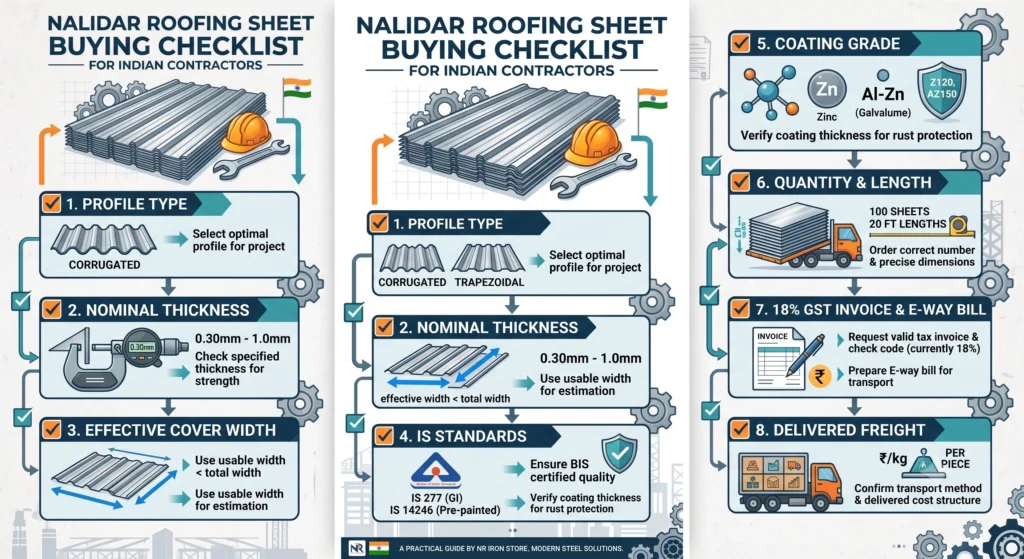
Before ordering, confirm:
- Sheet material
- Profile type
- Thickness
- Overall width
- Effective cover width
- Length
- Coating
- Grade
- Brand/manufacturer
- Quantity
- GST
- Freight
- Delivery schedule
- Accessories required
Don’t Buy Only by Thickness
Two sheets can have the same thickness but different profiles, coatings and effective coverage.
Therefore, compare the complete specification.
Ask for Effective Cover Width
This is especially important for estimating how many sheets are required.
Confirm Coating
For GI products, confirm the relevant coating specification rather than assuming every galvanized sheet has the same coating.
Check the Actual Requirement
For large roofing projects, provide the roof dimensions and structural details to the roofing supplier or engineer so the appropriate product can be selected.
Why Choose NR Iron Store?
NR Iron Store is a Jaipur-based iron and steel business serving customers looking for construction and fabrication materials.
For a roofing-sheet enquiry, provide:
- Required material
- Thickness
- Profile
- Length
- Quantity
- Delivery location
This allows the quotation to be prepared according to your actual requirement.
For current availability and pricing, contact NR Iron Store directly rather than relying on an old online rate.
Brand Website: NR Iron Store
Key Takeaways
- Nalidar roofing sheets generally refer to corrugated or profiled roofing sheets used for suitable roofing and cladding applications.
- GI/GC, colour-coated and galvalume/aluzinc products are different roofing options.
- Sheet thickness, profile, coating and effective cover width are important buying specifications.
- A roofing sheet’s overall width is not necessarily the same as its effective coverage after overlaps.
- Public Jaipur listings currently show nalidar galvanized sheet examples around ₹85/kg, while specific products can be listed higher or lower.
- Always compare suppliers using the same specification and delivered terms.
- For an exact current rate, request a quotation based on your size, thickness, profile, quantity and delivery location.
Frequently Asked Questions
1. What is a Nalidar Roofing Sheet?
A nalidar roofing sheet is a corrugated or profiled sheet commonly used for roofing and related cladding applications. In India, the term can refer to different materials, so the exact product specification should be confirmed.
2. What are metal roofing sheets used for?
Metal roofing sheets are commonly used for suitable residential, commercial, industrial, warehouse, parking-shed and agricultural structures.
3. What thickness is available in Nalidar Roofing Sheets?
Availability depends on the product and supplier. Public listings show examples ranging from around 0.5 mm upward, with some GI nalidar products listed in the 0.5–3 mm range.
4. What is the Nalidar Roofing Sheet Price Per Kg?
There is no single fixed price. Current public listings include examples around ₹68–₹102/kg, depending on product type, coating, thickness and supplier. A Jaipur listing specifically shows a nalidar galvanized sheet at around ₹85/kg.
5. What is the Nalidar Sheet Price in Jaipur?
A current public Jaipur listing shows a coated nalidar galvanized sheet at approximately ₹85/kg for a particular specification. Other roofing sheet products in Jaipur have different listed prices.
6. How do I calculate how many roofing sheets I need?
Calculate the roof area and divide it by the effective coverage area per sheet, then account for overlaps, roof geometry and cutting requirements.
For accurate ordering, use the manufacturer’s effective cover width.
7. Is a thicker roofing sheet always better?
Not necessarily.
The appropriate thickness depends on the roofing design, support spacing, loading, wind conditions, coating, profile and manufacturer’s recommendations.
8. What should I tell a supplier when asking for a roofing sheet quotation?
Provide:
Material + Profile + Thickness + Width + Length + Quantity + Delivery Location
For example:
GI Nalidar Sheet + 0.50 mm + 4 ft width + 12 ft length + 50 sheets + Jaipur delivery.
Get a Quote
Looking for Nalidar Roofing Sheets or Metal Roofing Sheets for a shed, warehouse, construction project or fabrication work?
Send NR Iron Store your:
Sheet Type + Thickness + Profile + Size + Quantity + Delivery Location
and request a current quotation.
GET A QUOTE
NR Iron Store: nrironstore.com
About the Author
Author: Muhammad Ahmad
Designation: Founder & Steel Operations Lead
Experience: 6+ Years in Steel Distribution & Fabrication Supply
Expertise: Steel products and Nalidar sheets information
Author Bio:
Muhammad Ahmad leads operations at NR Iron Store. With hands-on industry experience in steel trading and fabrication supplies, he creates practical guides to help Indian contractors, builders, and fabricators understand material specifications, grades, and quality standards before purchasing.