Profile PPGI Sheets are profiled roofing or cladding sheets made from pre-painted galvanized steel.
PPGI stands for Pre-Painted Galvanized Iron/Steel. The steel substrate has a metallic zinc coating and is then coated with paint to provide colour, appearance and additional protection.
The material is formed into profiles such as corrugated, trapezoidal or ribbed shapes for roofing and cladding applications.
The Bureau of Indian Standards’ IS 14246:2024 specifically allows continuously pre-painted galvanized steel sheets to be supplied in profiles, with profile dimensions and tolerances agreed between the purchaser and manufacturer.
Source: Bureau of Indian Standards — IS 14246:2024
For contractors, builders and fabricators, the important specifications are:
- Base steel thickness
- Overall sheet width
- Effective/cover width
- Sheet length
- Profile design
- Zinc coating
- Paint coating
- Colour and finish
- Grade
- Quantity
- Brand or mill
Important: A PPGI roofing sheet should not be selected only by colour or price. Thickness, coating and profile are equally important.
How Are Profile PPGI Sheets Made?
PPGI starts with galvanized steel.
The galvanized steel substrate is coated with a paint system and then formed into the required profile.
The result is a steel sheet that combines the metallic coating of galvanized steel with a coloured organic coating.
Tata Steel describes its PPGI product as pre-painted galvanized steel where the paint coating provides both protection and decoration.
Source: Tata Steel — Colornova
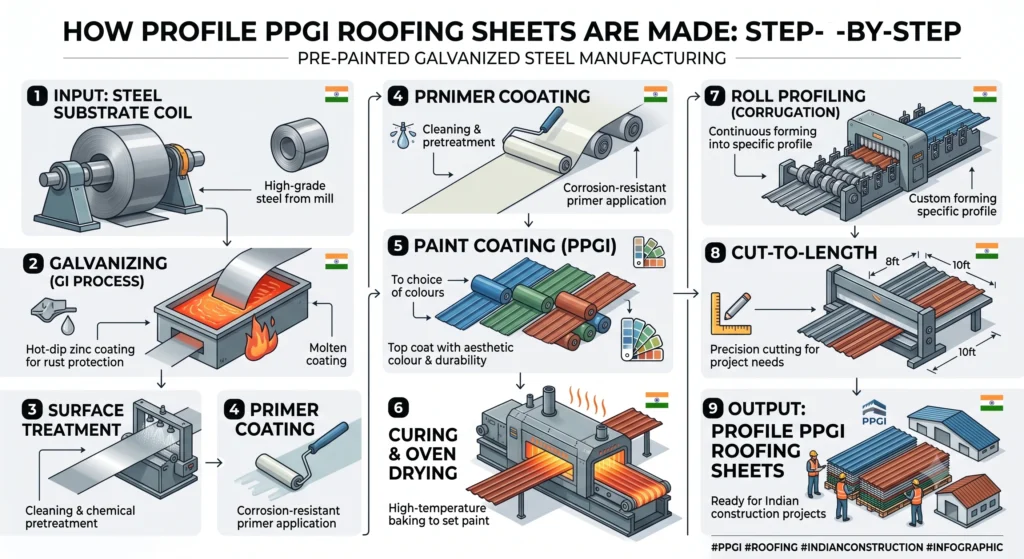
The simplified process is:
- Steel substrate preparation
- Galvanizing with zinc
- Surface treatment
- Primer application
- Paint/top coating
- Curing
- Profiling/forming
- Cutting to required length
- Inspection and packing
The exact coating system and manufacturing process can vary between products and manufacturers.
Types of Profile PPGI Sheets
Profile PPGI sheets are available in different shapes and configurations.
The right profile depends on the roofing design, span, appearance, drainage requirement and structural design.
1. Corrugated PPGI Sheets
Corrugated sheets have repeated curved or wave-like ribs.
They are commonly used for:
- Sheds
- Farm buildings
- Warehouses
- Small commercial structures
- Wall cladding
2. Trapezoidal PPGI Sheets
Trapezoidal profiles have angular ribs rather than rounded corrugations.
They are widely used for roofing and wall cladding where a more structured profile is required.
3. Ribbed PPGI Sheets
Ribbed sheets use raised longitudinal ribs.
The ribs provide the sheet with its profiled form and can contribute to stiffness.
4. Tile Profile PPGI Sheets
Tile-profile sheets are formed to resemble traditional tiled roofing.
They can be useful when the project requires a more decorative roof appearance while using a lightweight steel roofing material.
5. Special / Custom Profiles
Manufacturers may offer other profiles depending on the production line and project requirement.
JSW’s colour-coated product information lists profiles including corrugated, trapezoidal, ribbed, Mangalore tile, wave and arch-trapezoidal profiles.
Source: JSW Steel — Colour Coated Steel Product Information
PPGI Sheet Sizes and Thickness Chart
There is no single universal PPGI profile-sheet size that applies to every manufacturer.
Under IS 14246:2024, profiled PPGI sheets can be supplied according to mutually agreed dimensions and tolerances between the purchaser and manufacturer.
Source: BIS — IS 14246:2024
In the market, buyers commonly specify sheets by:
- Thickness
- Overall width
- Effective cover width
- Length
- Profile height
- Number of sheets required
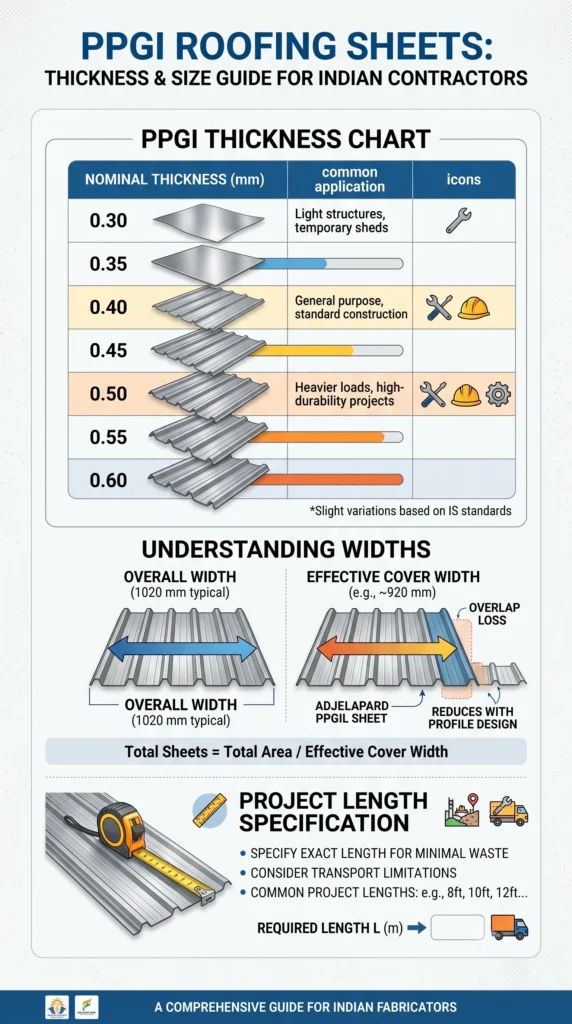
PPGI Sheet Thickness Chart
| Thickness | Typical Use Consideration |
| 0.30 mm | Light-duty roofing where suitable |
| 0.35 mm | Light/general roofing applications |
| 0.40 mm | General roofing and cladding |
| 0.45 mm | More demanding roofing applications |
| 0.50 mm | Stronger roofing/cladding requirements |
| 0.60 mm | Heavy-duty or higher-performance applications |
| 0.80 mm+ | Special/project-specific requirements |
Note: These are practical market categories, not a universal classification. The suitable thickness depends on span, support spacing, wind/load requirements, profile geometry and manufacturer’s specification.
JSW’s PPGI coil specification lists a much broader substrate thickness range of 0.18–1.5 mm, demonstrating that PPGI products are not limited to the commonly stocked roofing thicknesses.
Source: JSW Steel — Colour Coated Steel Product Brochure
Common PPGI Sheet Lengths
Profile sheets can be cut to length depending on the manufacturer’s equipment and project requirement.
Common project enquiries may include lengths such as:
- 6 ft
- 8 ft
- 10 ft
- 12 ft
- 14 ft
- 16 ft
- 18 ft
- 20 ft
These should be treated as market examples, not a fixed standard range.
For large roofing projects, ordering sheets to the required roof slope length can reduce unnecessary joints and overlaps.
PPGI Sheet Width: Overall Width vs Effective Width
This is an important point that many first-time buyers miss.
A profiled sheet has an overall width, but after overlapping adjacent sheets, the usable effective cover width can be smaller.
For example, a supplier might quote a sheet by its overall width while the contractor calculates the roof area using effective coverage.
Therefore, always ask:
“What is the effective cover width after overlap?”
This gives you a more accurate estimate of the number of sheets required.
PPGI Sheet Weight Calculation
PPGI sheets are often purchased on a per-kg basis, while roofing requirements are calculated by area.
That makes weight calculation useful for contractors and fabricators.
For a simplified steel calculation:
Weight ≈ Length × Width × Thickness × 7.85
Where:
- Length = metres
- Width = metres
- Thickness = millimetres
- 7.85 = approximate steel density factor
Example
Suppose a flat-equivalent sheet is:
- Length = 3.66 m
- Width = 1.0 m
- Thickness = 0.45 mm
Estimated steel weight:
3.66 × 1.0 × 0.45 × 7.85 ≈ 12.9 kg
For a profiled sheet, actual weight and coverage should be checked against the manufacturer’s specifications because profile geometry, dimensions and coating affect the supplied product.
Tip for fabricators: For billing and project costing, use the supplier’s actual declared or weighed mass rather than relying only on a theoretical calculation.
Common Uses of Profile PPGI Sheets
PPGI profile sheets are used in many roofing and cladding applications.
Industrial Sheds
PPGI roofing is commonly considered for:
- Factories
- Workshops
- Warehouses
- Storage sheds
- Industrial buildings
Commercial Buildings
They can be used for:
- Shops
- Commercial sheds
- Service centres
- Market structures
- Small business premises
Agricultural Structures
Profiled colour-coated steel can also be used for:
- Farm sheds
- Storage structures
- Agricultural buildings
- Equipment shelters
Residential and Utility Roofing
Depending on the design, PPGI sheets can be used for:
- House extensions
- Garages
- Car parking shelters
- Utility areas
- Outdoor covered spaces
Wall Cladding
PPGI profiles are not limited to roofs.
They can also be used for wall cladding and building envelopes.
BIS identifies pre-painted galvanized steel under IS 14246 for applications including roofing, architectural siding, home appliances and other general articles.
Source: Bureau of Indian Standards — IS 14246:2024
JSW also identifies roofing, cladding, facades, partitions, sandwich panels and other construction applications for colour-coated steel.
Source: JSW Steel — Colour Coated Steel
Benefits of Profile PPGI Sheets
1. Attractive Appearance
PPGI sheets are available in different colours and finishes.
This gives builders more options than plain galvanized roofing.
2. Corrosion Protection
The galvanized substrate provides zinc-based corrosion protection, while the paint system provides an additional protective layer.
The actual durability depends on the coating system, environment, thickness and maintenance.
3. Lightweight Roofing Solution
Steel roofing sheets can provide a large roof coverage area without the mass associated with many conventional roofing materials.
This can make transportation and installation easier.
4. Easy to Handle
Profile sheets can be manufactured in project-specific lengths, which can simplify handling and installation.
5. Suitable for Roofing and Cladding
The same basic PPGI material can be used in different profiles for roofs, walls and architectural applications.
6. Consistent Factory-Applied Finish
Unlike painting steel after installation, PPGI receives its coating under controlled manufacturing conditions.
Tata Steel notes that pre-coated colour sheets provide uniformity and performance advantages compared with post-coated products.
Source: Tata Steel — Colornova
PPGI vs GI vs PPGL Sheets
These three products can look similar but have different coating systems.
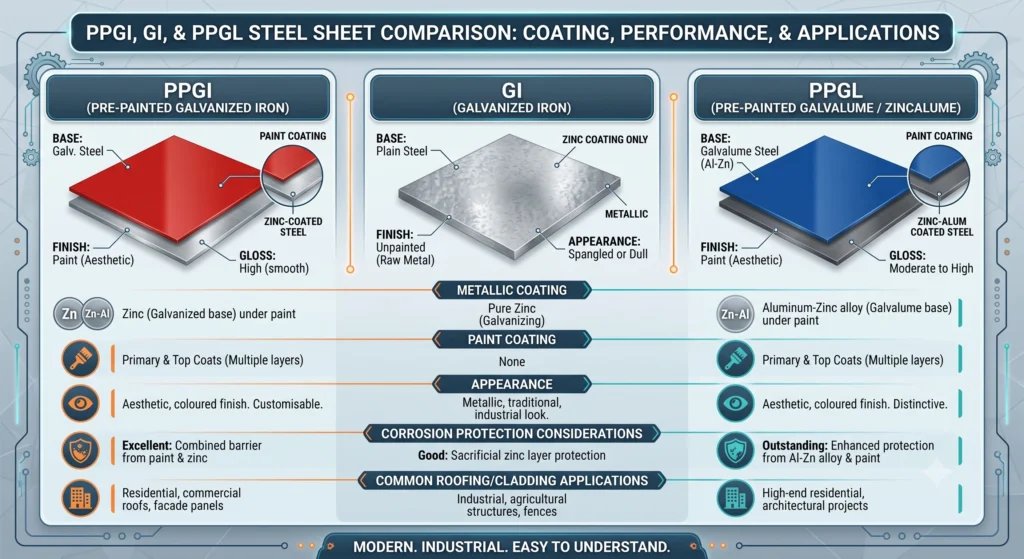
| Feature | PPGI | GI | PPGL |
| Full form | Pre-Painted Galvanized Steel | Galvanized Iron/Steel | Pre-Painted Galvalume Steel |
| Base coating | Zinc | Zinc | Aluminium-zinc alloy |
| Paint coating | Yes | No | Yes |
| Appearance | Coloured | Metallic | Coloured |
| Common uses | Roofing, cladding, buildings | Roofing, fabrication | Roofing, cladding |
| Main selection factor | Paint + zinc system | Zinc coating | Alloy coating + paint system |
PPGI is based on galvanized steel with a paint system.
PPGL uses a different metallic coating system, typically aluminium-zinc based.
The best choice depends on the environment, application, design requirements and project budget.
PPGI Profile Sheet Price Per Kg in India
One of the most common searches from buyers is:
“PPGI profile sheet price per kg”
There is no single fixed price because PPGI sheets are sold in different thicknesses, coating specifications, profiles, brands and colours.
As a current market reference, Tata Nexarc reported indicative August 2026 PPGI roofing prices of approximately ₹65–₹108 per sq ft, depending on thickness, coating and brand.
Source: Tata Nexarc — Roofing Steel Sheet Prices, updated August 6, 2026
Another Delhi supplier listing currently displays a PPGI roofing sheet at ₹85/kg, but this is an individual supplier quotation and should not be treated as a national market rate.
Source: Shiva Steel Fabricator — PPGI Roofing Sheet Listing
Indicative PPGI Price Guide
| Product / Market Reference | Indicative Price |
| PPGI roofing market reference | ₹65–₹108/sq ft |
| Example supplier listing | ₹85/kg |
| Final project price | Quote-based |
Important: These are indicative references only. Your actual PPGI sheet price can change according to thickness, profile, brand, colour, coating, quantity, GST, freight and location.
For a project in Jaipur, the delivered rate can also differ from a factory or Delhi-market quotation because transportation and supply conditions are different.
Why PPGI Price Per Kg and Per Sq Ft Can Look Different
This causes confusion for many customers.
A supplier may quote:
₹/kg
while another supplier may quote:
₹/sq ft
Both can be valid pricing methods.
The relationship depends on:
- Thickness
- Steel density
- Sheet width
- Profile
- Coating
- Weight
- Effective coverage
Example
A thicker sheet generally contains more steel per square metre.
Therefore, comparing two PPGI sheets only by their per-sheet price can be misleading.
For a proper comparison, check:
Thickness + coating + effective coverage + weight + brand + final delivered price.
Factors Affecting PPGI Sheet Price
1. Thickness
Thickness is one of the most important price and weight factors.
A 0.50 mm sheet and a 0.35 mm sheet should not be compared purely on price.
2. Zinc Coating
The metallic coating specification affects product performance and cost.
3. Paint System
Different paint systems, coating thicknesses, colours and finishes can affect the final price.
4. Brand
Branded material can carry a premium because of product consistency, certification, coating specifications and distribution.
5. Profile
Different profiles require different forming processes and may have different coverage and material requirements.
6. Quantity
A bulk project order can receive a different commercial rate from a small retail requirement.
7. Sheet Length
Custom cut-to-length requirements can influence handling, production and transportation costs.
8. Freight and GST
The final delivered price should account for applicable taxes and transportation.
Buying Tip: Ask for a complete quote rather than comparing only the basic ₹/kg number.
How to Choose the Right PPGI Profile Sheet
Step 1: Determine the Application
First decide whether the sheet is required for:
- Roofing
- Wall cladding
- Shed construction
- Warehouse
- Farm structure
- Residential extension
- Commercial building
Step 2: Check Structural Requirements
The required thickness and profile should be selected according to the structural design.
For roof applications, the supporting structure, span, purlin spacing, wind conditions and imposed loads matter.
BIS notes that profiled PPGI sheets supplied for structural applications should meet the relevant imposed-load conditions specified with reference to IS 875 Part 2.
Source: BIS — IS 14246:2024 Product Manual
Step 3: Choose Thickness
Do not choose thickness only because it is cheaper.
The correct thickness depends on the project requirements.
Step 4: Select the Profile
Choose corrugated, trapezoidal, ribbed, tile or another suitable profile according to the roof design.
Step 5: Confirm Effective Width
Always ask for the effective cover width after overlap.
Step 6: Compare Complete Quotes
Compare:
- Thickness
- Grade
- Coating
- Paint system
- Profile
- Effective width
- Length
- Brand
- GST
- Freight
This gives a much more meaningful price comparison.
Real-Life Example for a Fabricator
Hypothetical example:
A fabricator receives a requirement for a colour-coated roof for a workshop.
Instead of simply asking:
“PPGI sheet ka rate kya hai?”
the fabricator should provide:
- Required thickness
- Profile
- Approximate roof area
- Required sheet length
- Preferred colour
- Quantity
- Delivery location
For example:
“Need 0.45 mm PPGI trapezoidal roofing sheets, approximately 12 ft length, required for a workshop roof. Please quote material and delivery.”
This gives the supplier enough information to prepare a more useful quotation.
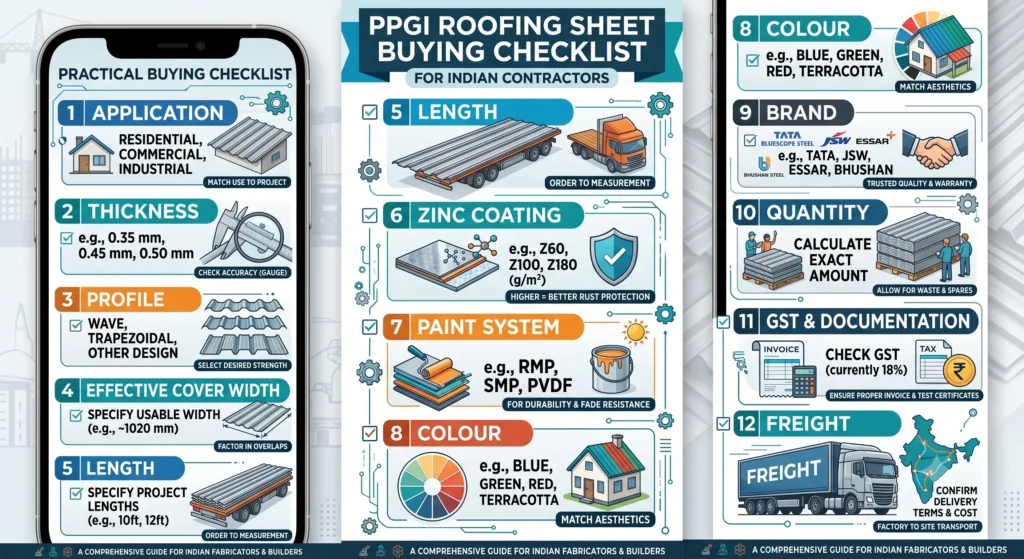
PPGI Sheet Buying Checklist
Before buying Profile PPGI Sheets, confirm:
- PPGI specification
- Thickness
- Profile type
- Overall width
- Effective cover width
- Required length
- Zinc coating
- Paint coating/system
- Colour
- Brand/mill
- Quantity
- GST
- Freight
- Delivery time
- Applicable standard/certification, if required
For large commercial or industrial projects, ask the supplier for the relevant product specification and test documentation.
Key Takeaways
- Profile PPGI Sheets are pre-painted galvanized steel sheets formed into roofing or cladding profiles.
- Common profiles include corrugated, trapezoidal, ribbed and tile-style profiles.
- There is no single universal PPGI sheet size; profile dimensions can be agreed between buyer and manufacturer.
- Thickness must be selected according to structural and application requirements.
- Always distinguish overall width from effective cover width.
- PPGI prices vary with thickness, coating, profile, brand, colour, quantity, freight and market conditions.
- Current market references should be treated as indicative, not as a guaranteed NR Iron Store selling price.
- For a reliable quotation, provide the supplier with thickness + profile + length + quantity + location.
Frequently Asked Questions
1. What are Profile PPGI Sheets?
Profile PPGI Sheets are pre-painted galvanized steel sheets formed into profiles for roofing, wall cladding and other building applications. BIS’s IS 14246:2024 recognises the supply of pre-painted galvanized steel sheets in profiles.
2. What does PPGI stand for?
PPGI commonly refers to Pre-Painted Galvanized Iron/Steel. It is galvanized steel with an organic paint coating applied before the material is formed or used.
3. What thicknesses are available in PPGI profile sheets?
Common roofing requirements may include approximately 0.30 mm to 0.60 mm, although the actual range is much broader.
For example, JSW lists PPGI coil thickness from 0.18 mm to 1.5 mm for its specified product range.
4. What are common PPGI sheet sizes?
PPGI profile sheets can be supplied in different widths and cut-to-length configurations.
The exact dimensions depend on the profile, manufacturer and project requirement.
Always confirm the effective cover width rather than relying only on overall sheet width.
5. What is the PPGI profile sheet price per kg in India?
There is no fixed nationwide rate.
A current Delhi supplier listing shows ₹85/kg for a PPGI roofing sheet, while market pricing can vary considerably according to thickness, coating, brand, profile and location.
For a broader current market reference, Tata Nexarc reported PPGI roofing prices of about ₹65–₹108/sq ft in August 2026.
6. Is PPGI better than GI roofing sheet?
PPGI offers the additional benefit of a factory-applied paint system and coloured appearance.
GI is galvanized steel without the same pre-painted finish.
The right choice depends on the project’s appearance, coating, durability and budget requirements.
7. Which PPGI profile is best for roofing?
There is no universally best profile.
Corrugated, trapezoidal, ribbed and tile profiles can all be suitable for different projects.
The correct profile should be selected according to structural design, support spacing, span, drainage and appearance requirements.
8. How do I calculate PPGI sheet quantity?
Start with the roof area and divide it by the effective cover area of one sheet.
Then account for overlaps, cutting, roof geometry and wastage.
For larger projects, it is better to prepare a proper roof-sheet layout rather than simply dividing total area by the nominal sheet size.
Need Profile PPGI Sheets for Your Project?
Whether you are a contractor, builder, fabricator or retail customer, NR Iron Store can help you compare your PPGI requirement based on the specifications that actually matter.
Send your:
- Required thickness
- Profile
- Sheet length
- Approximate quantity
- Colour preference
- Delivery location
and request a quotation.
Get a Quote from NR Iron Store
For roofing sheets, comparing only the per-kg price isn’t enough. Ask for the complete specification and delivered price so you can make a proper comparison.
About the Author
Author: Muhammad Ahmad
Designation: Founder & Steel Operations Lead
Experience: 6+ Years in Steel Distribution & Fabrication Supply
Expertise: Steel products and PPGI sheet information
Author Bio:
Muhammad Ahmad leads operations at NR Iron Store. With hands-on industry experience in steel trading and fabrication supplies, he creates practical guides to help Indian contractors, builders, and fabricators understand material specifications, grades, and quality standards before purchasing.