CR sheets, also called Cold Rolled Steel Sheets, are flat steel products manufactured by reducing the thickness of steel through a cold-rolling process.
The process helps achieve better dimensional accuracy, flatness and surface quality compared with many conventional hot-rolled products.
In India, cold-reduced carbon steel sheets for cold forming and drawing are covered under IS 513 (Part 1):2016. BIS also identifies grades ranging from CR0 through higher-formability grades under this standard.
Source: Bureau of Indian Standards — IS 513 (Part 1):2016
For contractors, fabricators and retail buyers, the important things to check are:
- Thickness
- Width and length
- Grade
- Surface finish
- Weight
- Quantity required
- Brand or mill
- Current market price
Quick Tip: Do not select a CR sheet only by thickness. The grade and intended application are equally important.
How Are CR Sheets Made?
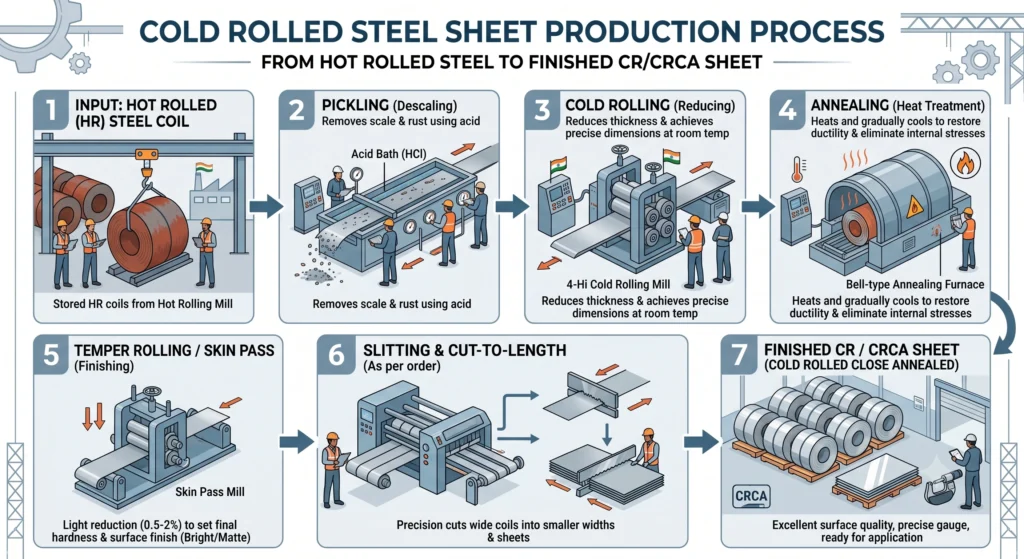
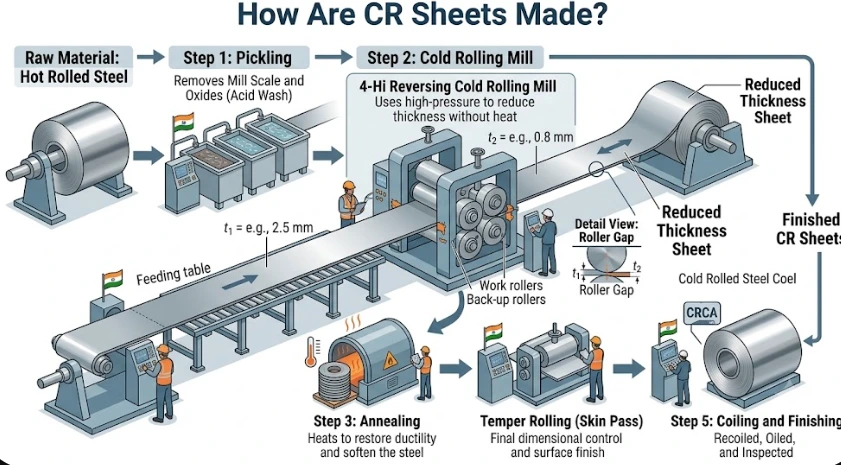
Cold rolled steel generally starts with hot-rolled steel that is further processed to achieve the required dimensions and surface characteristics.
During cold rolling, the steel is reduced at temperatures below the recrystallisation range. Further processing such as annealing and skin passing may be used depending on the required product.
CRCA stands for Cold Rolled Close Annealed. Annealing is used to modify the material’s mechanical properties and improve its formability.
Modern CR production focuses heavily on thickness control, flatness and surface finish. JSW Steel, for example, describes its CR products as having precision thickness control, flatness and uniform surface finish.
Source: JSW Steel — Cold Rolled Steel
Types of CR Sheets
CR sheets can be classified in several ways depending on grade, processing condition, surface finish and intended application.
1. CRCA Sheets
CRCA sheets are cold rolled and annealed products designed to provide good formability and surface quality.
They are commonly used where bending, forming, painting or a clean appearance is important.
Typical applications include:
- Furniture
- Electrical panels
- Automotive components
- Appliances
- General engineering
- Fabrication
Tata Steel lists auto ancillaries, panels, furniture and general engineering among typical applications of its cold rolled products.
Source: Tata Steel — Tata Steelium
2. CR Full Hard Sheets
Full-hard cold rolled steel has not undergone the same final annealing treatment used for fully annealed CRCA material.
It is generally selected where higher hardness and strength are required rather than maximum formability.
The exact properties depend on the grade and processing condition, so buyers should confirm the manufacturer’s specification before ordering.
3. Drawing Quality CR Sheets
Drawing-quality grades are designed for forming operations where the sheet needs to deform without cracking.
IS 513 includes different grades for increasing levels of forming and drawing requirements.
For example, CR2, CR3 and CR4 are used for progressively more demanding forming applications under the standard.
Source: BIS — IS 513 (Part 1):2016
4. High-Strength CR Sheets
High-strength and advanced grades are used when a component needs higher strength while maintaining suitable formability.
These products are especially relevant to automotive and engineering applications.
IS 513 Part 2 covers cold-reduced carbon steel sheet and strip for high-tensile and multi-phase steel applications.
Source: Bureau of Indian Standards — IS 513 Part 2
CR Sheet Grades
The grade should be selected according to the forming requirement rather than simply choosing the thickest or cheapest sheet.
A simplified view is:
| Grade / Category | Typical Requirement | Example Applications |
| CR0 | Full-hard/general requirements | Components requiring higher hardness |
| CR1 | Commercial quality | General fabrication and panels |
| CR2 | Drawing quality | Formed panels and components |
| CR3 | Deep drawing | More demanding formed components |
| CR4 | Extra deep drawing | Complex forming applications |
| CR5 / specialised grades | Very demanding forming | Critical stamped components |
The exact mechanical requirements, chemistry and tolerances should always be checked against the applicable standard and mill test certificate.
Source: BIS — IS 513 (Part 1):2016
CR Sheet Thickness and Sizes
CR sheets are available in different thicknesses and dimensions depending on the manufacturer, grade and application.
Commercial availability can include thin sheets below 1 mm as well as products around 3 mm or more. BIS-listed testing scopes for IS 513 Part 1 currently include products from 0.50 mm to 4.00 mm for specified grades.
Source: BIS LIMS — IS 513 Part 1 testing scope
Manufacturer ranges can differ considerably.
For example, JSW’s current CR product information shows different thickness and width ranges depending on grade and product configuration.
Source: JSW Steel — CR Product Range
Common CR Sheet Sizes
In the retail and fabrication market, buyers may commonly ask for sizes such as:
| Approx. Size | Common Buying Situation |
| 4 × 8 ft | General fabrication and retail |
| 3 × 6 ft | Smaller fabrication jobs |
| 4 × 10 ft | Larger panels and fabrication |
| Custom cut size | Specific fabrication requirements |
Availability varies by supplier, mill, thickness and stock.
If you need a particular size, it is better to confirm actual stock dimensions before placing the order.
CR Sheet Thickness Guide
Some commonly requested thicknesses include:
- 0.5 mm
- 0.6 mm
- 0.8 mm
- 1.0 mm
- 1.2 mm
- 1.5 mm
- 1.6 mm
- 2.0 mm
- 2.5 mm
- 3.0 mm
These should be treated as common market examples, not a universal manufacturer range.
The correct thickness depends on the application’s load, forming requirement, stiffness, fabrication method and design specification.
CR Sheet Thickness and Weight
One of the most useful calculations for fabricators and contractors is estimating the weight of a CR sheet before buying.
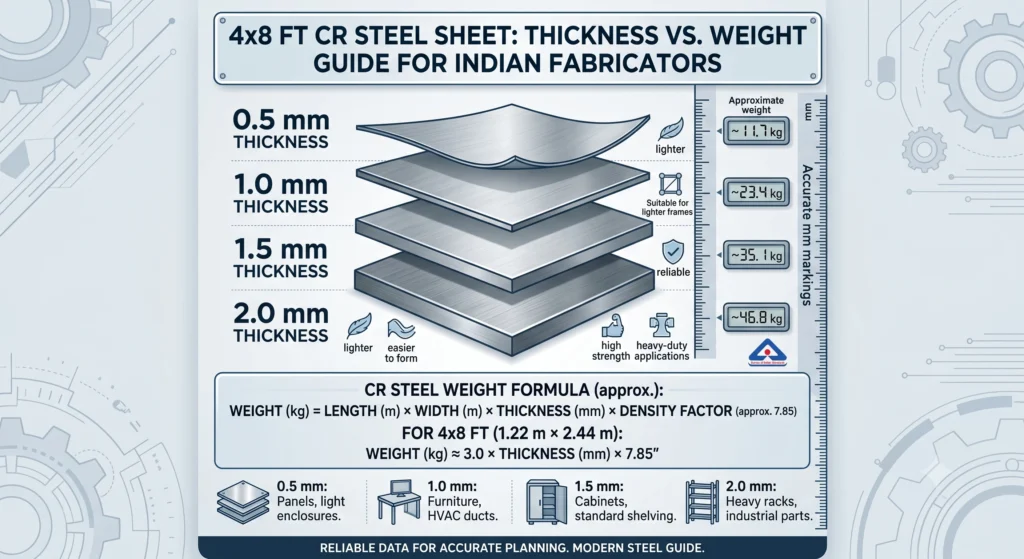
For ordinary carbon steel, a commonly used engineering density is approximately 7,850 kg/m³.
The approximate sheet-weight formula is:
Weight (kg) = Length (m) × Width (m) × Thickness (mm) × 7.85
Example: 4 × 8 ft CR Sheet
A 4 × 8 ft sheet is approximately:
- Length = 2.438 m
- Width = 1.219 m
- Thickness = 1.0 mm
Estimated weight:
2.438 × 1.219 × 1.0 × 7.85 ≈ 23.3 kg
Actual commercial weight can differ because of dimensional tolerances and the exact supplied product.
Approximate Weight Table for 4 × 8 ft Sheets
| Thickness | Approx. Weight |
| 0.5 mm | 11.7 kg |
| 0.8 mm | 18.6 kg |
| 1.0 mm | 23.3 kg |
| 1.2 mm | 28.0 kg |
| 1.5 mm | 35.0 kg |
| 1.6 mm | 37.3 kg |
| 2.0 mm | 46.6 kg |
| 2.5 mm | 58.3 kg |
| 3.0 mm | 69.9 kg |
Note: These are theoretical weights calculated using 7.85 kg per litre / 7,850 kg/m³ density. Use the supplier’s actual weighment for invoicing and dispatch.
Common Uses of CR Sheets
CR sheets are widely used where surface quality, dimensional accuracy and formability are important.
Automotive Applications
Cold rolled steel is used for various automotive panels and components where surface finish and forming performance matter.
JSW Steel identifies automotive panels and parts among CR applications.
Source: JSW Steel — Cold Rolled Steel
Electrical Panels
CR sheets are used for electrical enclosures and panels because their flatness and surface quality can be useful for fabrication and finishing.
Furniture
CR sheets are used in cabinets, storage systems, office furniture and other fabricated furniture products.
Home Appliances
Refrigerators, washing machines and other consumer durables use cold rolled steel for selected components and panels.
General Fabrication
Fabricators may use CR sheets for:
- Cabinets
- Enclosures
- Ducting
- Panels
- Light machinery components
- Furniture frames
- Fabricated boxes
Engineering Applications
Cold rolled products are also used in general engineering and industrial applications requiring controlled dimensions and surface quality.
Tata Steel and JSW Steel both identify furniture, panels and general engineering among CR applications.
Sources: Tata Steel; JSW Steel
CR Sheets vs HR Sheets
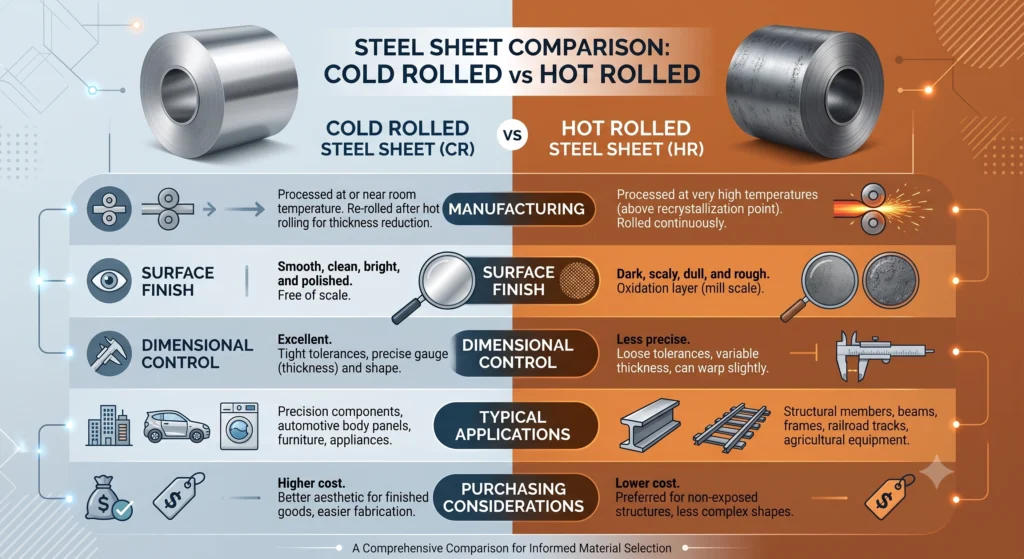
CR and HR sheets are both steel products, but they are produced and selected for different requirements.
| Feature | CR Sheet | HR Sheet |
| Manufacturing | Cold rolled | Hot rolled |
| Surface | Generally smoother | Generally rougher |
| Dimensional control | Generally tighter | Generally less precise |
| Appearance | Cleaner and more uniform | Mill-scale appearance may be present |
| Forming | Suitable grades offer good formability | Depends strongly on grade |
| Typical use | Panels, furniture, appliances, auto parts | Heavy fabrication, structures, machinery |
| Cost | Often higher for comparable products | Often more economical |
The choice should be based on the application rather than price alone.
For heavy structural fabrication, HR products may be more appropriate. For visible panels or precision fabrication, CR may be the better choice.
Factors Affecting CR Sheet Price
The CR sheet price per kg can change frequently.
Important factors include:
1. Thickness
Different thicknesses can have different market prices and availability.
2. Grade
Drawing-quality, deep-drawing and specialised high-strength grades may cost more than basic commercial grades.
3. Brand or Mill
Mill origin and brand can influence price because buyers may be paying for consistency, certification and specific quality requirements.
4. Quantity
Bulk orders can have different commercial pricing from small retail purchases.
5. Size
Standard sizes may be easier to source than unusual or custom dimensions.
6. Surface Finish
Bright, matt and other specified finishes can affect product selection and pricing.
7. Market Conditions
Steel prices fluctuate with raw material costs, supply, demand, freight and other market factors.
Important: A price shown online should not automatically be treated as today’s final landed price. Always confirm the current quote, GST, freight, brand, grade and actual specification with the supplier.
CR Sheet Price in India
There is no single fixed CR sheet price in India.
Recent online supplier listings show a broad range, with several ordinary CR sheet listings around ₹50–₹75/kg, while specialised or branded products can be quoted higher. These are market listings rather than an official national price index and can change with grade, thickness, quantity, location and taxes.
Sources: ExportersIndia; supplier listings
For example, a Jaipur supplier listing recently showed a CR sheet at approximately ₹53/kg for a 0.5 mm product, while other supplier listings show different rates.
Indicative Price Guide
| CR Sheet Category | Indicative Online Market Range* |
| Standard CR sheets | ₹50–₹75/kg |
| Branded / specified grades | ₹55–₹80+/kg |
| Special grades / finishes | Can be higher |
| Custom requirements | Quote-based |
*Indicative only. Prices vary by location, grade, thickness, quantity, brand, GST, freight and market conditions. Confirm the current quote before purchasing.
How to Choose the Right CR Sheet
Before buying, answer these five questions:
1. What will the sheet be used for?
A furniture panel and a deep-drawn automotive component do not necessarily require the same grade.
2. What thickness is required?
Choose thickness based on the engineering or fabrication requirement.
Do not simply select the thickest sheet because it weighs more.
3. Does the sheet need forming?
If bending, drawing or pressing is involved, ask for the appropriate formability grade.
4. Is surface appearance important?
For visible components, surface finish and flatness may be important.
5. Do you need certification?
For commercial or industrial work, ask whether a test certificate or specified standard compliance is required.
CR Sheet Buying Checklist
Before placing an order, confirm:
- Sheet type: CR / CRCA / full hard
- Grade
- Thickness
- Width
- Length
- Quantity
- Surface finish
- Brand / mill
- Applicable standard
- Test certificate requirement
- GST
- Delivery / freight
- Final weight and billing basis
This simple checklist can prevent many specification and pricing misunderstandings.
Key Takeaways
- CR sheets are cold-rolled steel products known for good surface quality and dimensional control.
- CRCA sheets are annealed cold-rolled products commonly selected for forming and fabrication applications.
- Thickness and grade should be selected according to the actual application.
- A 4 × 8 ft, 1 mm CR sheet theoretically weighs about 23.3 kg using a density of 7,850 kg/m³.
- CR sheet prices in India vary by grade, thickness, brand, quantity, location and market conditions.
- Always confirm the latest price and specification before placing an order.
Frequently Asked Questions
1. What is a CR sheet?
A CR sheet is a cold-rolled steel sheet manufactured to achieve controlled thickness, flatness and surface quality. CR sheets are widely used in automotive, furniture, appliances, electrical panels and engineering applications.
2. What does CRCA mean?
CRCA means Cold Rolled Close Annealed. It refers to cold-rolled steel that has undergone annealing to obtain the required mechanical properties and formability.
3. What is the standard for CR sheets in India?
Cold-reduced carbon steel sheets and strips for cold forming and drawing purposes are covered by IS 513 (Part 1):2016. High-tensile and multi-phase products are covered under Part 2.
Source: BIS
4. What is the weight of a 4 × 8 ft CR sheet?
Approximate theoretical weights are:
- 0.5 mm → 11.7 kg
- 1 mm → 23.3 kg
- 1.5 mm → 35.0 kg
- 2 mm → 46.6 kg
- 3 mm → 69.9 kg
Actual supplied weight may vary according to dimensions and tolerances.
5. What is the price of CR sheet per kg in India?
Online supplier listings recently show many standard CR sheet offers around ₹50–₹75/kg, but the actual rate depends on thickness, grade, brand, quantity, location, GST and freight.
6. Which is better, CR sheet or HR sheet?
Neither is universally better.
CR sheets are generally preferred when surface quality, dimensional control or forming performance is important, while HR sheets are commonly selected for heavier fabrication and structural applications.
7. What thicknesses are available in CR sheets?
Commonly requested thicknesses include 0.5, 0.8, 1.0, 1.2, 1.5, 1.6, 2.0, 2.5 and 3.0 mm.
Actual availability depends on the grade, manufacturer and supplier.
8. Where are CR sheets commonly used?
CR sheets are commonly used in automotive components, furniture, electrical panels, appliances, general engineering and fabrication.
Need CR Sheets for Your Project?
Whether you are a contractor, builder, fabricator or retail customer, choosing the correct CR sheet specification can save both material and fabrication costs.
For the latest availability, specification and pricing, contact NR Iron Store and request a quote based on your required:
- Thickness
- Size
- Grade
- Quantity
- Brand / mill preference
Get a Quote from NR Iron Store today for your CR Sheet requirement.
About the Author
Author: Muhammad Ahmad
Designation: Founder & Steel Operations Lead
Experience: 6+ Years in Steel Distribution & Fabrication Supply
Expertise: Steel products and CR sheet information
Credentials / Certifications: Not provided
Author Bio:
Muhammad Ahmad leads operations at NR Iron Store. With hands-on industry experience in steel trading and fabrication supplies, he creates practical guides to help Indian contractors, builders, and fabricators understand material specifications, grades, and quality standards before purchasing.