If you have ever purchased an MS angle, MS channel, MS flat, MS pipe or steel plate, you have probably come across the term mild steel.
But what exactly does mild steel mean?
Mild steel is a type of low-carbon steel that is widely used in construction, fabrication, engineering and general manufacturing.
India’s Ministry of Steel describes mild steel as low-carbon steel, normally containing up to about 0.3% carbon.
Its popularity comes from a practical combination of properties such as relatively good weldability, formability, machinability and strength.
For contractors, builders and fabricators, understanding these properties helps in selecting the right steel product for a particular job.
Mild Steel Meaning and Definition
Mild Steel Meaning
The simple mild steel meaning is:
Mild steel is low-carbon steel used for general-purpose construction, fabrication and engineering applications.
The term “mild” refers to its relatively low carbon content compared with medium- and high-carbon steels.
Lower carbon content generally improves the material’s ability to be welded and formed.
The Ministry of Steel classifies non-alloy steel into low-, medium- and high-carbon categories and identifies low-carbon steel as mild steel.
Mild Steel Definition
A practical mild steel definition is:
Mild steel is a low-carbon, non-alloy steel commonly selected where a combination of strength, ductility, weldability and ease of fabrication is required.
It is not one single grade.
Different mild-steel products can have different chemical compositions and mechanical properties depending on the applicable standard and grade.
What Is Mild Steel Made Of?
Mild steel is primarily iron with carbon as an important alloying element.
It can also contain smaller amounts of elements such as:
- Manganese
- Silicon
- Sulphur
- Phosphorus
The exact limits depend on the particular steel grade and applicable standard.
For structural steel in India, IS 2062 specifies requirements relating to chemical composition and mechanical properties for structural steel products such as plates, strips, sections, flats and bars.
Important: “Mild steel” describes a broad category. Always check the grade and applicable standard when a project has specific strength or certification requirements.
Mild Steel Properties
The properties of mild steel are a major reason for its widespread use.
1. Good Weldability
Mild steel is generally easier to weld than higher-carbon steels.
This makes it useful for fabricated structures, frames, supports and many general engineering components.
The suitability of a particular steel for welding still depends on its grade, thickness and welding procedure.
2. Good Formability
Low-carbon steel can generally be bent and formed more easily than higher-carbon steel.
This is useful when fabricators need to cut, bend, drill or shape steel components.
3. Ductility
Mild steel is generally ductile, meaning it can undergo deformation before failure rather than behaving like a very brittle material.
The actual ductility depends on the grade and manufacturing condition.
4. Strength
Mild steel provides useful strength for many general construction and fabrication applications.
However, not every mild-steel product has the same strength.
For structural applications, the specified grade should be checked rather than assuming all MS products have identical properties.
5. Machinability
Many low-carbon steels can be machined using conventional processes.
This makes them useful for fabricated and engineered components.
6. Recyclability
Steel is a recyclable engineering material, and steel products can be recovered and recycled at the end of their useful life.
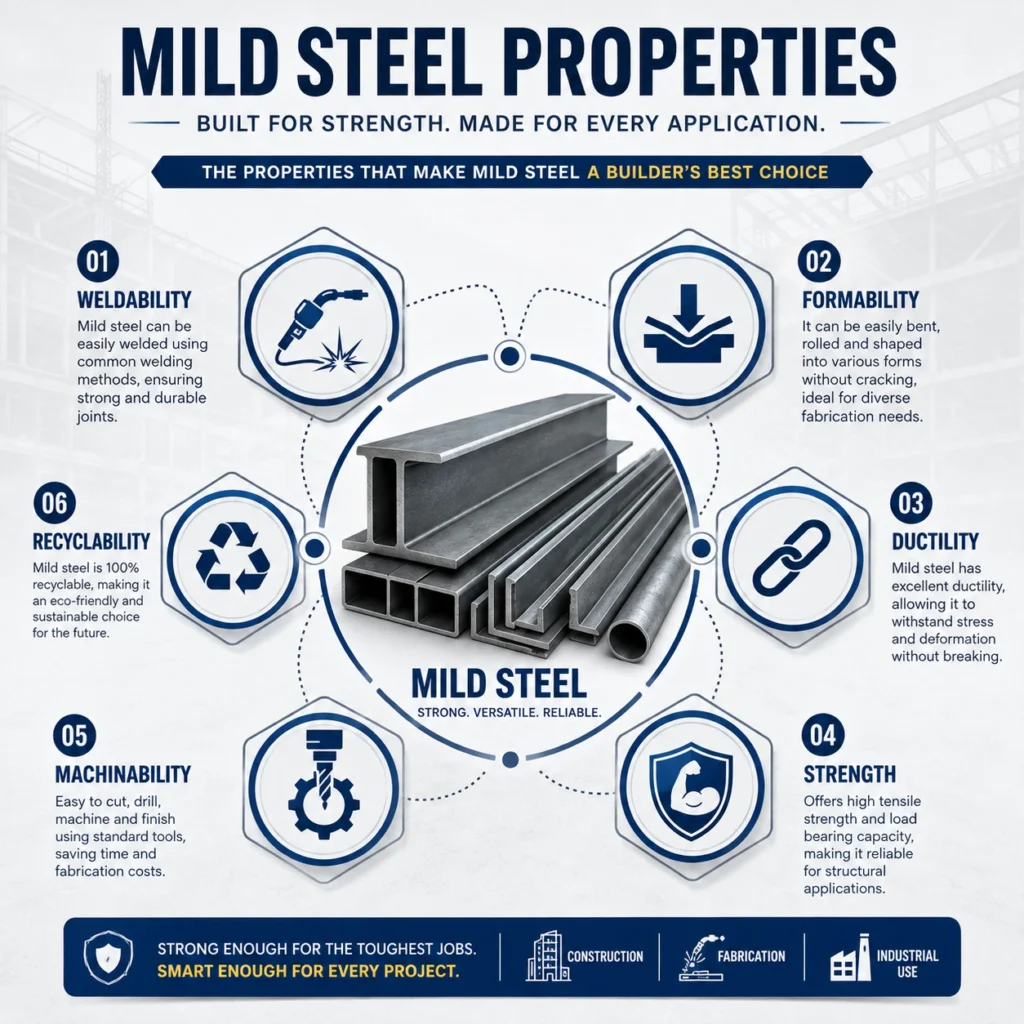
Mild Steel Properties at a Glance
| Property | What It Means for Users |
| Low carbon | Generally supports good weldability and formability |
| Ductility | Can deform before failure |
| Strength | Suitable for many general applications |
| Formability | Can be shaped and bent |
| Weldability | Useful for fabricated structures |
| Machinability | Suitable for many machining operations |
| Recyclability | Can be recovered and recycled |
Types of Mild Steel
There is no single universal list of “mild steel types.”
The term can be discussed according to carbon level, grade, manufacturing process or application.
1. Low-Carbon Steel
Low-carbon steel is the broad category most closely associated with mild steel.
The Ministry of Steel notes that mild steel normally contains up to about 0.3% carbon.
2. Commercial-Quality Low-Carbon Steel
These products are intended for general applications where basic forming and fabrication characteristics are required.
The exact specification depends on the relevant product standard.
3. Structural Mild Steel
Structural steel products are selected for applications where strength, ductility and other specified mechanical properties are important.
In India, IS 2062 covers hot-rolled structural steel products, including plates, strips, shapes, sections, flats and bars.
4. Drawing-Quality Low-Carbon Steel
Some low-carbon sheet products are manufactured for forming and drawing applications.
For example, India’s IS 513 covers cold-reduced carbon steel sheet and strip for cold forming and drawing purposes.
Important Point About Grades
A customer should not simply ask for “mild steel”, when a project has specific engineering requirements.
Instead, specify:
Product + grade + dimensions + applicable standard.
For example:
MS structural section + required grade + specified dimensions + applicable IS standard.
This makes purchasing much clearer.
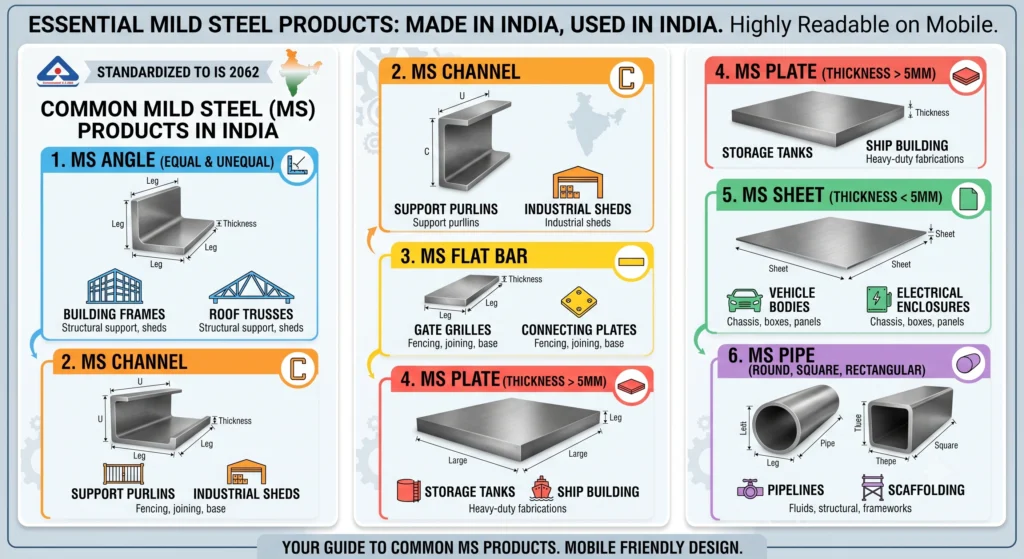
Common Forms of Mild Steel
Mild steel is available in many shapes and product forms.
MS Angle
MS angles have an L-shaped cross-section.
They are commonly used for:
- Frames
- Supports
- Brackets
- Structural fabrication
- Racks
MS Channel
MS channels have a channel-shaped cross-section.
They are commonly used for:
- Frames
- Supports
- Structural members
- Fabricated structures
MS Flat
MS flats are rectangular steel bars.
They are useful for:
- Brackets
- Frames
- Gates
- Supports
- Fabrication work
MS Plate and Sheet
These are flat steel products used in:
- Fabrication
- Machinery
- Structural work
- Tanks and enclosures
- Industrial components
MS Pipe
MS pipes are used for a wide variety of structural, fabrication and engineering purposes.
The correct pipe specification depends on the intended application.
What Is Mild Steel Used For?
So, what is mild steel used for?
The answer is: a very wide range of construction, fabrication and engineering work.
Common applications include:
- Building structures
- Industrial sheds
- Gates and grills
- Railings
- Frames
- Supports
- Machinery components
- Storage racks
- Agricultural equipment
- General fabrication
- Engineering components
The exact product and grade should be selected according to the requirements of the application.
Mild Steel in Construction and Fabrication
Construction
Mild and structural steels are used in construction for products such as:
- Angles
- Channels
- Beams
- Flats
- Plates
- Bars
- Other structural sections
IS 2062 specifically covers structural steel products including angles, tees, beams, channels, flats and bars.
Fabrication
Fabricators value mild steel because many low-carbon steel products can be cut, drilled, bent and welded using common fabrication processes.
A fabricator may use different MS products together to create a finished structure.
Example: Workshop Frame
Hypothetical example:
A fabricator is making a small workshop frame.
The project might require:
- MS angles for selected frames
- MS channels for supports
- MS plates for connection components
- MS flats for brackets
The exact sizes and grades should be determined from the design and load requirements.
This is why simply asking for “MS” is often not enough when ordering material.
Mild Steel vs Other Types of Steel
Mild steel is only one category within the wider family of steels.
| Feature | Mild / Low-Carbon Steel | Medium-Carbon Steel | High-Carbon Steel |
| Carbon level | Lower | Higher | Higher still |
| Weldability | Generally good | More demanding | Generally more difficult |
| Formability | Generally good | Moderate | Lower |
| Typical use | Construction & fabrication | Engineering components | Tools, springs and wear applications |
| Hardness potential | Relatively lower | Higher | Higher |
Carbon ranges can vary by classification system, so the table should be viewed as a general comparison rather than a specification for purchasing material.
The Ministry of Steel’s glossary classifies mild steel as normally up to about 0.3% carbon, medium carbon steel around 0.3–0.6%, and high carbon steel above about 0.6%.
Mild Steel vs Stainless Steel
Mild steel and stainless steel are selected for very different requirements.
| Factor | Mild Steel | Stainless Steel |
| Main characteristic | Low-carbon steel | Corrosion-resistant alloy steel |
| Typical appearance | Usually needs finishing/coating for appearance or protection | Often used with corrosion-resistant surface |
| Corrosion resistance | Generally needs protection in corrosive environments | Generally much higher |
| Cost | Often economical for general fabrication | Usually higher |
| Common uses | Structures, frames, fabrication | Food equipment, chemical applications, architectural uses |
If corrosion resistance is a major requirement, the project may need a different steel grade rather than ordinary mild steel.
Advantages of Mild Steel
Why is mild steel so widely used?
Its main advantages include:
- Good weldability
- Good formability
- Useful strength
- Easy availability in many product forms
- Suitable for general fabrication
- Available in many sizes and sections
- Compatible with common fabrication processes
- Often economical for general-purpose work
These advantages make mild steel a practical choice for many construction and fabrication requirements.
Limitations of Mild Steel
Mild steel is useful, but it is not suitable for every application.
Corrosion
Unprotected mild steel can corrode when exposed to moisture and suitable corrosive environments.
Common protection methods include:
- Painting
- Galvanizing
- Protective coatings
- Appropriate maintenance
Temperature and Special-Service Requirements
Applications involving unusual temperatures, aggressive chemicals or highly specialised mechanical requirements may need a different steel grade.
Grade Selection
Not every MS product has the same mechanical properties.
For structural applications, use the specified grade and standard rather than choosing material based only on the label “mild steel.”
How to Choose Mild Steel for Your Project
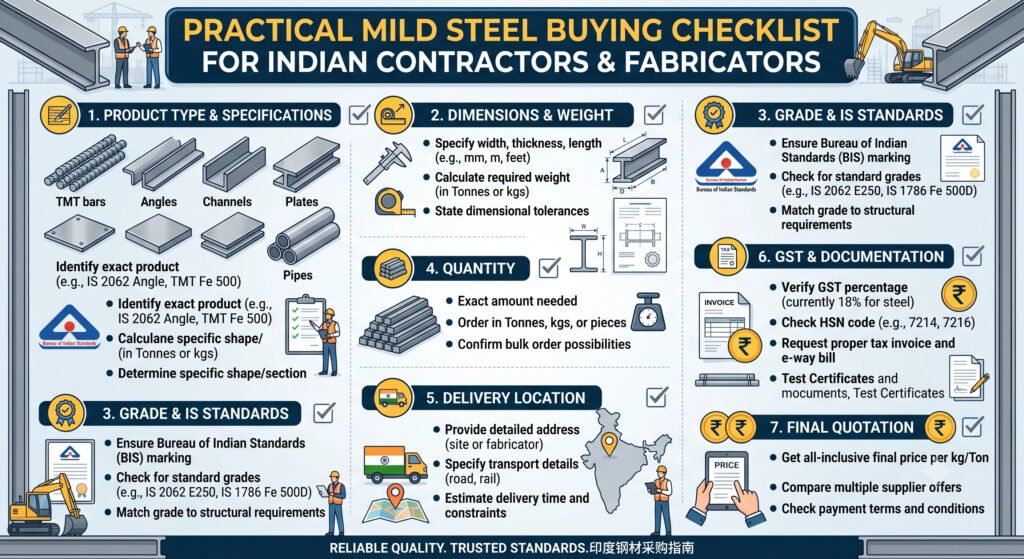
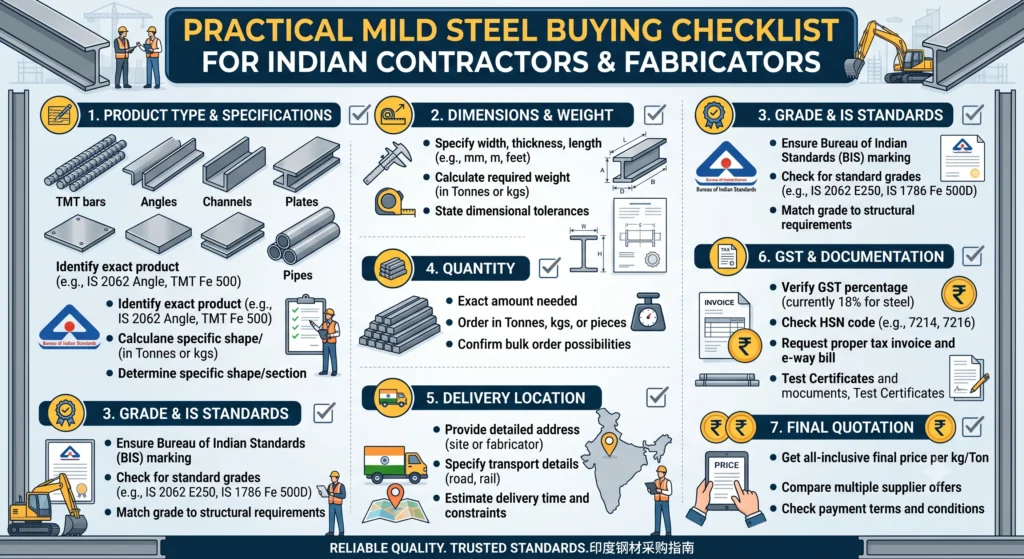
Before purchasing, identify the following:
1. Product Type
Do you need:
- MS angle?
- MS channel?
- MS flat?
- MS plate?
- MS pipe?
- MS bar?
2. Dimensions
Specify:
- Thickness
- Width
- Length
- Diameter, where applicable
- Section size
3. Grade
If the project has an engineering specification, mention the required grade.
4. Applicable Standard
For structural work, confirm the applicable Indian Standard.
IS 2062 is an important Indian standard for hot-rolled medium- and high-tensile structural steel.
5. Quantity
Tell the supplier whether you need a few pieces or a larger project quantity.
6. Delivery Location
Freight can affect the final delivered cost.
Buying Tip: Ask for a complete quotation with product specification, dimensions, grade, quantity, GST and delivery terms.
Mild Steel for Contractors, Builders and Retail Customers
Different buyers have different priorities.
Contractors
Contractors usually need dependable supply, correct dimensions and material that matches the project specification.
Builders
Builders may need structural sections and plates according to engineering drawings and project standards.
Fabricators
Fabricators often focus on:
- Weldability
- Dimensions
- Surface condition
- Ease of cutting
- Bending requirements
- Availability
Retail Customers
Retail buyers may simply know the job they need to complete.
A good supplier can help them identify the appropriate product dimensions and quantity based on the requirement.
Key Takeaways
- Mild steel is low-carbon steel widely used in construction and fabrication.
- The Ministry of Steel describes mild steel as normally containing up to about 0.3% carbon.
- Important mild steel properties include weldability, formability, ductility and useful strength.
- Mild steel is available as angles, channels, flats, plates, sheets, pipes and other products.
- “Mild steel” is a broad category, so the exact grade and standard matter for engineering applications.
- For structural products in India, IS 2062 is an important standard to check where applicable.
- The right MS product should be selected based on application, dimensions, grade and project requirements.
Frequently Asked Questions
1. What is mild steel?
Mild steel is a type of low-carbon steel commonly used in construction, fabrication and general engineering. India’s Ministry of Steel describes mild steel as normally containing up to about 0.3% carbon.
2. What is the mild steel meaning?
The simple meaning of mild steel is low-carbon steel. It is widely used because it generally offers a useful combination of strength, ductility, weldability and formability.
3. What are the main properties of mild steel?
Important properties include:
- Weldability
- Formability
- Ductility
- Strength
- Machinability
- Recyclability
The exact mechanical properties depend on the grade and product specification.
4. What are the types of mild steel?
Mild steel is a broad low-carbon steel category rather than one single grade.
It can be discussed as commercial-quality, structural and drawing-quality low-carbon steel, depending on the product and application.
5. Where is mild steel used?
Mild steel is used in construction, structural fabrication, industrial sheds, frames, gates, railings, machinery components, racks, supports and many general engineering applications.
6. Is mild steel good for welding?
Many low-carbon steels have good weldability, which is one reason they are widely used in fabrication.
However, the exact grade, thickness, joint design and welding procedure should be considered for important structures.
7. Is mild steel the same as structural steel?
Not exactly.
Mild steel describes a low-carbon steel category, while structural steel refers to steel specified for structural applications with defined mechanical and other requirements.
Some structural steels are low-carbon steels, but the terms should not automatically be treated as interchangeable.
8. What is IS 2062 mild steel?
IS 2062 is an Indian Standard covering hot-rolled medium- and high-tensile structural steel.
It specifies requirements for structural products including plates, strips, shapes, sections, flats and bars.
Need Mild Steel for Your Project?
Whether you need MS Angle, MS Channel, MS Flat, MS Plate, MS Pipe or another steel product, choosing the correct specification is important.
Share your:
- Product requirement
- Size
- Thickness
- Grade, if specified
- Quantity
- Delivery location
with NR Iron Store and request a quotation.
Get a Quote from NR Iron Store
Get the material specification and pricing together so you can compare your options properly.
About the Author
Author: Muhammad Ahmad
Designation: Co-Founder & Steel Operations Lead
Experience: 6+ Years in Steel Distribution & Fabrication Supply
Expertise: Steel products, construction materials and fabrication information
Credentials / Certifications: Certified Steel Merchant | BIS (IS 2062 / IS 1786) Standards & Material Sourcing
Author Bio:
Muhammad Ahmad leads operations at NR Iron Store. With hands-on industry experience in steel trading and fabrication supplies, he creates practical guides to help Indian contractors, builders, and fabricators understand material specifications, grades, and quality standards before purchasing.
Author Profile URL: Not provided